 Gumroad



 Polar
 Kelviq
 Stan

Feature
Offer a useful checkout extra without selling the same thing twice
Order bumps and upsells give buyers a choice to add something useful or select a more capable edition, at checkout or after the original purchase. On EXNO, use a bump for a distinct optional item; explain explicitly when an upgrade replaces a lower edition. The buyer who declines must still receive everything the original product promised. 16
Is the extra offer an addition, an upgrade or another purchase?
An order bump presents an optional addition during checkout, while an upgrade changes the package the buyer is considering and a post-purchase offer follows the original purchase. EXNO supports related offers at checkout or afterward, but those placements still need clear explanations of contents, price and what accepting changes. 16
| Offer | Illustrative relationship | Question to resolve |
|---|---|---|
| Checkout addition | An optional practice workbook alongside a tutorial. | What does it add to the total? |
| Genuine upgrade | A larger asset edition instead of the smaller package. | Does it replace the original selection? |
| Post-purchase offer | A separate resource relevant to the completed order. | What new purchase is being proposed? |
Review the EXNO checkout features against the relationship you intend. A later offer does not establish automatic charging, stored-card reuse or one-click payment; verify the actual acceptance flow. 1
“Offer a related product at checkout or right after the purchase.”
How do you configure a relevant offer without confusing the original purchase?
Start with a main product that fulfills its description without extras, then choose an additional offer with a distinct purpose. Use the product-specific checkout presentation to explain that relationship and review both acceptance and decline, checking that the buyer can still complete the original purchase without choosing the addition. 6
- Define the extra value. Identify the separate task the additional product helps with. Do not move an essential promised file out of the main package.
- Choose the placement. Decide whether the offer belongs during checkout or afterward, and configure it for the relevant main product rather than treating every catalog item alike.
- Explain addition versus replacement. State the contents and price. For alternative editions, inspect whether acceptance replaces or adds to the original selection; avoid an unintended double purchase.
- Check both routes. Review the selected products, total and access instructions after acceptance. Decline the extra and confirm the main offer remains available. 6
Offer an extra that earns its place beside the purchase
A useful extra extends the buyer’s chosen project without making the original purchase incomplete. Offer optional resources or a genuinely different license, make declining straightforward, and reject unrelated additions rather than treating every checkout as a place to sell anything else in your catalog.
A planning workbook could offer a separate sample-data pack; a brush set could offer optional practice exercises. A personal-use template might instead offer a clearly explained team license as an alternative, not a second license the buyer accidentally purchases alongside the first. Keep essential instructions, promised captions, and necessary accessible formats in the base offer.
Decline the temptation to attach an unrelated stock-photo bundle simply because it is available. The buyer should understand how the extra fits before opening the payment flow for the selected offer; verify the actual checkout behavior rather than assuming every placement works identically.146
| Completed-order group | Orders | Base revenue | Optional $8 pack revenue |
|---|---|---|---|
| Accepts the optional pack | 12 | $360 | $96 |
| Declines the optional pack | 38 | $1,140 | $0 |
Fifty completed $30 base orders generate $1,500, plus $96 from twelve accepted packs: $1,596 total and $31.92 average order value. The attachment rate is 12 ÷ 50 = 24% among these eligible completed orders, not all visitors.
The extra $96 is revenue, not incremental profit or proof that conversion stayed unchanged. Compare abandoned checkouts and fulfillment costs separately. For a postpurchase offer, measure acceptance against customers actually shown that offer; do not silently reuse the completed-base-order denominator when exposure differs.
How do you keep additional offers genuinely optional?
Test the path that declines every extra as carefully as the path that accepts one, keeping the original purchase accessible in both cases. Buyers should understand the additional cost, what they receive, and whether payment is one-time or recurring before committing, without mistaking an optional offer for a required completion step.
- Buy only the original item. Follow the checkout without selecting additions. Confirm that its total, confirmation, and delivery match the advertised offer. EXNO documents upsells and order bumps; their presence is not evidence that every configuration handles every edge case correctly. 16
- Add and remove before paying. Where an order bump is offered, test selecting it and reversing that choice. Check the final total and item list after removal, not just the visual state of a control.
- Decline after purchase. Skip any post-purchase offer and verify access to the item already paid for. Avoid wording that makes declining sound like abandoning the completed purchase or losing its contents.
- Inspect acceptance separately. For a post-purchase offer that creates another transaction, make that commitment explicit. Check the amount, charge timing, included benefits, and any recurring interval before acceptance, then reconcile the resulting confirmation with the choice.
The FTC identifies obscured fees and unwanted recurring payments as dark-pattern concerns. These checks guide responsible design; they are not a universal legal ruling or complete accessibility assessment. 8
“Provide ways for users to confirm, correct, or reverse important submissions.”

After payment, how do you reconcile the order with access?
Match the buyer’s receipt to the products they selected and the access they actually received, treating the original purchase and any additional transaction separately. A successful charge is not proof of correct fulfillment: confirm the files, library entries, or other promised benefits before deciding that an upgrade journey is complete.
Start with a short reconciliation record: original item, optional addition, amount charged, transaction reference, and delivered entitlement. Compare the receipt with the buyer’s library or applicable delivery route. Check that declining an extra still leaves the original item accessible; accepting it should add precisely the promised benefit, not silently replace something the buyer already owns. EXNO documents private product delivery and post-purchase presentation, but each configured offer still needs this check. 16
If the base item is an EXNO-hosted course, check that the lessons open even when a student declines a companion download. If the proposed addition is a membership, name the renewal interval and show how the buyer can manage the subscription; it is not the same as a one-time file purchase. 14
Describe the commercial relationship accurately. An upgrade charging only the difference is not the same as purchasing a second full-price product. Do not assume previous spending is credited automatically. If the extra repeats files already owned, explain what new value is included instead of presenting the entire bundle as new.
Standard sales: 7%. Discover sales: 7%. Additional fees may apply to payment processing, payouts and other transactions. See the Seller Agreement for current fees and terms. Record the actual acquisition source for each order. The source does not change the edition, license or buyer rights promised by the offer.
For an apparent duplicate charge or missing item, compare transaction references and confirmations before concluding that two completed purchases occurred. Direct buyers to the receipt’s support route and the EXNO refund policy; EXNO handles refunds as merchant of record, and a refunded purchase loses its product access and license. 45
Log failed purchase attempts, abandoned offer steps, and repeated buyer questions separately. Report observed problems rather than labeling every decline a lost sale.
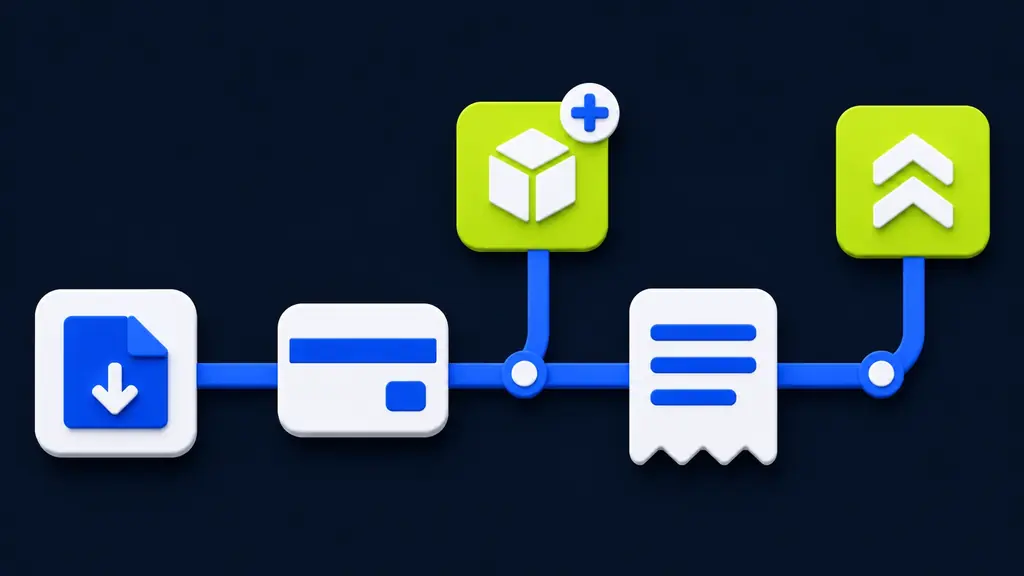
Show a main route with a genuinely optional branch
A main lane with a small branching path can represent the difference between a complete product and an optional extra. Use that motif on the EXNO Pixel Wall to lead visitors to an accurate product page, not to suggest that choosing the branch is necessary to finish a purchase.
The wall’s one million pixels cost $1 each, purchased once by card or from EXNO earnings. Choose an available block, supply artwork, a title and a destination, and submit it for review before display. Buying space does not configure a checkout offer.

Questions about optional purchases, consent and delivered access
A related offer works only when the buyer understands whether it adds something, replaces a selection or starts another purchase. These answers address the points where an attractive checkout can become confusing, from mutually exclusive editions and recurring commitments to a receipt that does not match the available files.
When should I offer another edition instead of an order bump?
Use an edition choice when the packages are alternatives, such as a smaller collection versus a larger collection containing it. A complementary product serves a separate purpose alongside the main purchase. Verify whether the actual selection replaces or adds to the original item so buyers do not unintentionally pay for both. 16
Can a buyer decline the extra and still buy the main product?
That should be the experience for an optional addition. Test the decline route and keep every item necessary to fulfill the main description within the main purchase. Do not call a required component an optional enhancement. 68
Does a post-purchase offer charge the buyer as soon as it appears?
EXNO’s public description establishes the placement, not automatic charging or a stored-card acceptance mechanism. Review the actual flow and make the extra product, amount and acceptance action clear before another purchase is finalized. W3C’s financial-error guidance describes review and correction as one safeguard against consequential mistakes. 17
What if the additional product renews rather than charging once?
Explain the recurring amount, billing interval, access and cancellation terms before acceptance. Do not present a renewing membership as a one-time accessory or infer consent from the original purchase. The FTC’s report identifies unwanted recurring charges and obscured terms as examples of problematic design, not a specification of EXNO controls. 458
Are the additional download files publicly exposed in checkout?
EXNO describes private delivery that releases files to buyers after payment and keeps covers separate from deliverables. Show a representative preview rather than publishing the paid files as promotional material. Private delivery does not mean a downloaded copy cannot be shared. 1
What should I check if the receipt and available files disagree?
Compare the order’s purchased products with the edition names, file list and access instructions promised at checkout. Ask the buyer for the order number and identify the missing or incorrect item without requesting payment credentials. Resolve the delivery mismatch or direct the buyer to EXNO’s support and refund process rather than asking them to buy again. 56
Can someone request a refund for an unintended extra?
They can use the receipt link or contact EXNO support with the order number. EXNO’s policy covers specified circumstances including unauthorized charges, duplicate charges for the same order and unresolved delivery or product faults; a change of mind is not an unconditional refund entitlement after digital delivery. Applicable legal rights and any displayed creator refund window still matter. 5
Is a higher product subtotal the same as a higher final charge?
No: distinguish the selected product prices from the final checkout total. Review the full amount after the extra is selected rather than presenting an illustrative subtotal as an all-in promise. 4
General information, not tax or legal advice.
Platform documentation and safeguards for purchase decisions
EXNO’s feature, checkout, payment and refund pages establish the platform claims and support routes described here. W3C explains safeguards for consequential submissions, while the United States FTC report illustrates misleading purchase designs; neither source verifies an EXNO configuration, and the example product relationships are editorial illustrations rather than observed sales results.
- EXNO product and storefront features · Private digital file delivery, product editions, checkout links and storefront tools· checked 19 November 2026
- EXNO · The public marketplace where shoppers browse digital products by category· checked 19 November 2026
- EXNO seller pricing· checked 19 November 2026
- EXNO payments · The buyer transaction and EXNO’s merchant-of-record responsibilities· checked 19 November 2026
- EXNO refund policy· checked 19 November 2026
- EXNO: Checkout Builder · Checkout offers and explaining the relationship to the main purchase· checked 19 November 2026
- W3C: error prevention for financial and other consequential submissions · Options for helping users avoid consequential mistakes, including review and correction· checked 19 November 2026
- U.S. Federal Trade Commission: report on dark patterns · Examples of designs that obscure terms or trick people into purchases; not a universal statement of law· checked 19 November 2026


Build one extra offer with an equally clear way to decline
Choose a complete main product and one related item whose value you can explain without repeating the original promise. Configure the relationship, review the acceptance and decline paths, and check what the buyer receives before extending the same approach to other products in your catalog.
Keep reading

Feature
Build an affiliate program around your digital products
An affiliate program on EXNO lets you set a commission rate while partners promote your digital products through their own links and coupons. You also have affiliate analytics to review activity and inform your next campaign. Start with a product you can explain clearly, a commission you have worked through, and partners whose audience has a reason to use it.
Read the guide
Feature
What can EXNO AI help you decide as a seller?
EXNO AI is an AI assistant for online sellers that answers questions in your language from the chat bubble at the lower right of the dashboard, 24 hours a day. Use it to understand an EXNO rule, review your store, compare prices on Discover or work on an idea; involve the EXNO team when the situation needs a person.
Read the guide
Feature
Design your EXNO storefront by telling the builder what should change
EXNO’s AI Store Builder lets you change your storefront design through a conversation and refine the result with drag-and-drop editing. Instead of asking for a “better store,” tell it who is visiting, what they need to find and which part of the page should move.
Read the guide