 Gumroad



 Polar
 Kelviq
 Stan

Feature
How to test a checkout change and decide whether to keep it
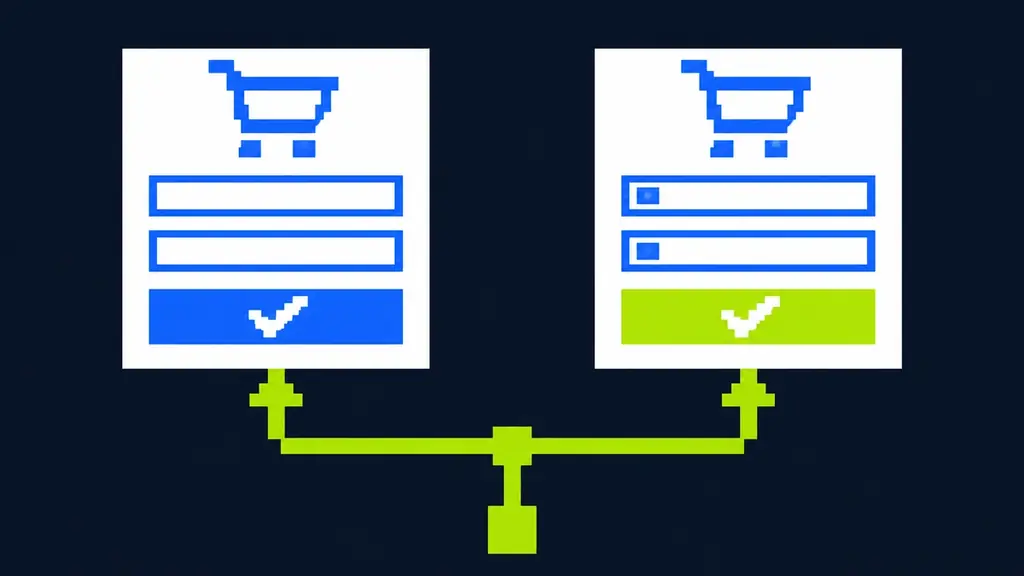
Checkout A/B testing compares two versions of the buying experience for the same product to see whether a deliberate change helps customers complete their purchase. EXNO offers checkout A/B testing and analytics alongside a Checkout Builder with 12 designs. Start with one buyer question, one change, and one result that would justify keeping it.

Which checkout changes are good candidates for an A/B test?
Test a change when buyers have a real choice to make and both alternatives describe the same honest offer. A useful test asks whether a clearer description, different layout, or better explanation of an optional item helps someone decide; it does not ask whether hiding material information can produce more purchases.
| Buyer question | Change one thing | Hold fixed |
|---|---|---|
| What am I getting? | For an illustration bundle, compare “Studio pack” with “12 editable illustrations” when the same 12 files are supplied. | Files, price, checkout design, acquisition channels, and delivery. |
| What is the add-on? | Keep the same optional template upgrade but compare a vague description with one naming the extra files. | Both prices, the optional nature of the add-on, and what each edition includes. |
| Can I understand this on my phone? | Compare the current layout with a different design for the same product. | Copy, price, discount, terms, and offer. You are testing the overall layout, not proving one individual visual element caused a change. |
Do not use an experiment to decide whether to correct a broken purchase link, illegible total, or inaccurate promise. Fix those. A good candidate might be a buyer who understands the base price but repeatedly asks whether a membership renews: first make the recurring commitment unambiguous in both versions, then compare how well two clear explanations work.
If you have no evidence of a sticking point, start with an observation rather than a redesign. Ask someone unfamiliar with the product to explain what they expect after paying. Their answer can suggest a hypothesis; it is not a reason to claim a measured conversion improvement.
How do you set up a fair checkout comparison?
Write your hypothesis before creating the alternative, define who counts in each group, and choose a primary measure that matches the change. Keep other parts of the offer steady and compare versions during the same period where possible; otherwise a launch, a source of traffic, or a weekend can masquerade as an effect of the design.12
- Write one prediction. For example: “Naming the file formats will help more checkout visitors finish their purchase without increasing questions about compatibility.” Choose the completion measure first, and treat support questions as a check on unintended consequences.
- Prepare the two versions for one product. In EXNO, use the product’s checkout design and A/B testing tools. Label the baseline and alternative in your notes and record their exact difference, launch time, price, and active promotion. Test both purchase paths on a small screen and a large one before interpreting results.
- Use comparable audiences. A controlled experiment uses random assignment; sending newsletter readers to one version and first-time marketplace visitors to the other confounds design with audience. Confirm how exposure and repeat visits are counted in the reporting available to you. If you cannot establish that the groups are comparable, describe the numbers as observations, not a causal test.12
- Plan the decision. Decide how large a change would matter, how many eligible visitors you reasonably need, and which normal sales cycles to include. Fix the analysis point beforehand for a fixed-horizon test; there is no universal seven-day rule or minimum order count that fits every shop.23
What does a higher conversion rate actually tell you?
A higher observed conversion rate tells you that more of the counted participants purchased in one group during the test, relative to that group’s size. It does not by itself show that the design caused the difference, that the result is precise, or that the business made more money after refunds and selling costs.
Worked example, not store results: suppose each group contains 500 independently assigned eligible checkout visitors, each counted once, and each buyer can place only one order in this comparison. Version A has 28 buyers and version B has 35. A converts at 5.6%, B at 7.0%: the observed difference is 1.4 percentage points, or 25% relative to A. “Up 25 points” would describe a much larger change.
If the experiment ended at its planned analysis point, a simple large-sample 95% interval for B minus A is approximately −1.6 to +4.4 percentage points. That range includes zero: the seven additional purchases in this illustration do not establish a reliable winner. The interval is an example calculation from the two counts, not a claim about a statistical feature in EXNO.5
Also check what customers purchased. Suppose those same 28 buyers spent an average of $25, while the 35 buyers spent an average of $20. Both groups generated $700, or $1.40 per eligible visitor before costs and refunds. A bigger conversion rate and unchanged revenue can both be true. This distinction is particularly important when evaluating upsells and order bumps.

When should you keep, reject, or rerun a checkout change?
Keep a version when reliable evidence supports a practically meaningful improvement without an unacceptable cost elsewhere. Reject a change that introduces confusion or a broken purchase experience; when counts are small, the traffic mix changed, or the plausible outcomes point in different directions, keep the baseline and record the result as inconclusive.
Use EXNO’s product views, checkout opens, completed sales, and earnings to see where the question belongs. A fall from product views to checkout opens happens before the buyer sees the tested checkout. A store-wide weekly conversion rate also combines products, devices, and sources; it cannot substitute for a comparable by-version result. The guide to creator analytics explains how to read those steps together.
Watch for harm, not an early winner. Stop to fix a serious defect if buyers cannot pay or receive a misleading total. That is different from peeking every morning and stopping at the first favorable figure. Similarly, if only one of many audience slices looks positive, treat that pattern as a possible question for a new test, not confirmation of your original claim.36
Save the dates, exact versions, denominator, result, and decision in a short log. If the sample is too small to learn from, ask buyers to explain where they hesitated or make a clearly justified usability fix instead. For the underlying product-specific checkout and related tools, see EXNO’s seller features.
Make a small study in contrast on the Pixel Wall
A checkout test asks whether a difference matters to buyers; a tiny pixel composition asks whether a difference is even visible. A pair of neighboring shapes in your store colors can make a distinctive rectangle on EXNO’s shared wall, with a title and an optional link back to your work.
Choose the size at $1 per pixel. If you want to support the platform, add your design to the EXNO Pixel Wall; approved spaces remain on the wall.
Questions about running and interpreting checkout tests
When a result looks surprising, start with the purchase path and the counting rules before changing the design again. The relevant questions are whether both groups could buy the same thing, whether comparable visitors were counted in each, and whether the result is large and precise enough to guide a real decision.
Is testing two different weeks the same as an A/B test?
No. The difference between weeks may reflect a promotion, payday, seasonality, or different audiences. If you cannot run a comparable concurrent test, use a before-and-after comparison to generate ideas rather than attributing the change to the checkout.12
How much traffic do I need before changing the checkout?
The amount depends on your baseline, the size of change you need to detect, and the uncertainty you are willing to tolerate. Low traffic may still reveal a usability problem, but it may be unable to distinguish a small improvement from chance.2
Can sales rise while revenue per visitor stays flat?
Yes. More customers can buy while choosing lower-priced items or declining optional add-ons. Calculate total revenue divided by the same eligible population to see whether the conversion gain also changed revenue per visitor.
General information, not tax or legal advice.
Sources
The design and experiment references explain random assignment, measurement choices, repeated looks, and checks for imbalanced test groups. Penn State provides the method behind the illustrative interval for two independent proportions; the example sales and revenue are invented solely for arithmetic and are not reported outcomes for EXNO stores.
- NIST: random assignment in a controlled experiment· checked 20 November 2026
- Kohavi, Henne, and Sommerfield: practical guidance on online controlled experiments and sample size· checked 20 November 2026
- Microsoft Research: monitoring experiments, deciding when to stop, and checking for harm· checked 20 November 2026
- Microsoft Research: diagnosing an unexpected imbalance between test groups· checked 20 November 2026
- Penn State: approximate confidence intervals for two independent proportions· checked 20 November 2026
- NIST: multiple comparisons and choosing the comparisons before seeing results· checked 20 November 2026


Start with one checkout decision worth testing
Choose one product and one point where a customer might reasonably hesitate, then write down what would persuade you to keep the current design. A test that can support either outcome is more useful than one built only to produce a favorable headline about the new version.
Keep reading

Feature
Build an affiliate program around your digital products
An affiliate program on EXNO lets you set a commission rate while partners promote your digital products through their own links and coupons. You also have affiliate analytics to review activity and inform your next campaign. Start with a product you can explain clearly, a commission you have worked through, and partners whose audience has a reason to use it.
Read the guide
Feature
What can EXNO AI help you decide as a seller?
EXNO AI is an AI assistant for online sellers that answers questions in your language from the chat bubble at the lower right of the dashboard, 24 hours a day. Use it to understand an EXNO rule, review your store, compare prices on Discover or work on an idea; involve the EXNO team when the situation needs a person.
Read the guide
Feature
Design your EXNO storefront by telling the builder what should change
EXNO’s AI Store Builder lets you change your storefront design through a conversation and refine the result with drag-and-drop editing. Instead of asking for a “better store,” tell it who is visiting, what they need to find and which part of the page should move.
Read the guide