 Gumroad



 Polar
 Kelviq
 Stan

Guide
Set a price your buyer can justify and your product can sustain
To decide how to price digital products, combine what it costs to fulfill each sale, what a buyer would otherwise pay or do, and the actual value of the rights, files or support you include. Choose a starting price that leaves a positive contribution, explain the offer, and test it with comparable buyers. Your break-even calculation is a constraint, not proof anyone will buy. 78

What should a digital product price account for?
A defensible price connects the buyer’s alternatives and expected value with the cost of keeping your promise. Separate upfront work from costs that grow with each order, then estimate the contribution left by a sale rather than assuming a downloadable file costs nothing to sell or support.
| Input | Examples | Question |
|---|---|---|
| Fixed or upfront costs | Initial production, testing and allocated overhead. | What must sales collectively recover? |
| Variable costs | Selling charges, per-order support and licensed usage. | What remains from an additional sale? |
| Buyer alternatives | Another product, manual work or hiring help. | What meaningful difference can you demonstrate? |
| Scope and permissions | Supported version, included revisions or team use. | What exactly does this price purchase? |
Use EXNO Discover as one place to inspect comparable offers, not as a record of what buyers actually paid. Compare file contents, license scope, support and date; a listing that looks cheap may not include the editable version your customer needs. 28
Contribution is revenue less the variable costs assigned to that sale; it still has to cover fixed costs before becoming profit. Keep the calculation’s assumptions visible, including support effort, and do not double-count a cost already included elsewhere.
“Use your competitor's prices as a guide, but don’t copy them exactly.”
Which pricing model matches the commitment you are making?
Choose a model that makes the purchased scope understandable, rather than adding tiers or recurring charges simply because the platform supports them. A fixed price suits a defined deliverable, distinct editions can reflect different rights or contents, and recurring pricing needs a clearly explained ongoing benefit and commitment.
- Fixed purchase: a finished illustration set or specified software release with stated support and update boundaries.
- Distinct editions: a personal-use package and a separately defined team license, with differences that buyers can recognize rather than arbitrary labels.
- Recurring access: an actively maintained service or continuing resource, with the renewal interval, access and cancellation consequences explained.
Review the EXNO pricing and subscription tools after defining the offer. Supported settings do not establish the right price, automatic license enforcement or a reason to charge repeatedly for an unchanged promise. 1
Find the contribution that can repay your setup work
A useful price floor starts with what each sale contributes after its variable costs, not with revenue alone.
List the fixed work needed to prepare a release and the variable work needed for each buyer. Keep your own delivery and support costs separate from platform charges, and use the Seller Agreement when choosing the inputs for an EXNO scenario.
Subtract all applicable variable costs from the selling price before estimating how many sales recover your setup work. Round the required number of sales upward, and label the result as a scenario rather than a guarantee of demand or profit.
Tax collected from buyers is not your income. Standard sales: 7%. Discover sales: 7%. Additional fees may apply to payment processing, payouts and other transactions. See the Seller Agreement for current fees and terms.
If contribution is zero or negative, no finite number of those sales repays a positive setup cost. Change the price, costs, or offer instead of increasing volume blindly. This simplified floor is a planning check, not a complete profit forecast or evidence that buyers will accept the price.
How can you test a price without confusing the result?
Compare prices for the same product, rights, and support promise while keeping the traffic mix as stable as practical. Choose a success measure before testing, such as contribution per visitor, and include refunds and support time so a larger order count does not disguise a less sustainable offer.
- Define the comparison. Record the release, license, included help, sales channel, and test dates. Changing the bundle and its price together tests a different offer, not price alone. Note seasonal events or campaign changes that could affect who arrives.
- Choose a meaningful outcome. For contribution per visitor, divide proceeds after relevant variable costs and refunds by the comparable visitor count. Define which costs are included and avoid presenting this operating measure as accounting profit. Track support minutes separately or value them consistently; do not count the same cost twice.
- Allow outcomes to mature. Compare equivalent observation periods and record later refunds or delivery problems against their original sales. A busy launch day and a quiet ordinary week are not interchangeable evidence. With limited traffic, report uncertainty rather than declaring a winner from a handful of orders.
- Revisit the economics. Check whether the candidate price can cover variable costs and contribute toward fixed costs at plausible sales volumes. SBA’s break-even guidance treats the calculation as an estimate, not a guarantee of financial results. No test establishes one universally optimal digital-product price. 7
“Finding your break-even point will help you price your products smarter.”

Which pricing promises remain your responsibility?
You decide what the price buys: files, usage rights, support, future releases, or continuing benefits, and those promises must remain clear at checkout. EXNO supplies the transaction infrastructure, but it does not choose a sustainable price for you or turn an unclear product description into an enforceable, understandable offer.
Start with the boundary of the purchase. A source-file edition may justify a different price from a finished PDF, while a broader license should describe the actual additional permission. EXNO supports editions and private delivery; neither means you can sell rights you do not hold or promise compatibility you have not tested. Keep product accuracy and delivery quality in your own review process. 1
Use tools to express a decision, not to avoid making one. A product payment link can take buyers directly to the chosen offer. Pay-what-you-want can allow an amount above a minimum without changing the promised rights. A subscription should state its renewal interval and continuing benefits, rather than presenting a recurring charge as an ordinary one-time purchase. 16
Review the actual checkout total for the configured offer and make the timing of any recurring commitment understandable. EXNO acts as merchant of record for the customer transaction; your own income taxes, business obligations and product promises remain separate. 4
Budget the obligations behind the number. A lower-priced download with bounded help may be more maintainable than a premium offer with unlimited revisions. Write down response expectations and update scope before launch, then revise future pricing transparently without silently rewriting what previous buyers purchased.
If customers regularly ask about a billed amount, compare their order summary with the listing and identify whether the issue is a tier label, checkout charge or renewal. EXNO’s Help Center is the route for payment or receipt questions; changing your public sticker price will not resolve an already completed order. 5
A fixed unit price is not a measure of every buyer’s value
The EXNO Pixel Wall offers a useful contrast: each cell has a fixed $1 price, although the value of a particular placement may differ between buyers. A balanced pair of pixel blocks can illustrate that distinction without suggesting that the same unit-price logic determines what your digital product should cost.
The full grid has a million cells; only the area you select is yours to pay for. Use a card or seller earnings for the one-time charge. A title and optional link may accompany the artwork through review. Record the cost as promotion, not evidence of demand.

Pricing questions about cost, scope and sustainable commitments
Price decisions become clearer when you separate the economics of an order from the buyer’s reason to choose it. These answers address common mistakes in valuing production time, interpreting competitor prices and adding paid commitments, without treating a particular format or number as a universal route to profit.
Should I divide my production hours by the first few sales?
That can show one recovery scenario, but it does not establish what customers will pay. Model more than one sales volume and keep your compensation assumptions visible. Test the offer against buyer alternatives rather than presenting an optimistic recovery forecast as demand. 8
Why can a product with almost no delivery cost still need a meaningful price?
Delivery is only one cost. Development, maintenance, customer questions and selling charges can remain even when another copy is inexpensive to provide. Account for the work required to keep the promise instead of equating low copying cost with zero operating cost.
Is contribution per sale the same as profit?
No: contribution is what remains after the variable costs included in your model. Fixed costs still need to be covered, and omitted work or expenses can make the apparent result misleading. State which costs the calculation includes before using it to compare prices.
Should I undercut the cheapest similar listing?
Not without comparing scope, quality, rights and support. A cheaper listing may serve a different buyer or exclude something your offer includes. Research alternatives as evidence, not as an instruction to match the lowest visible number. 8
Can identical files have different prices for different licenses?
They can represent different offers when the permissions genuinely differ and are clearly stated. Explain who may use the files and for what purpose rather than making buyers infer rights from a tier name. Do not imply that selecting a tier automatically enforces its license technically.
When is a subscription more suitable than a one-time purchase?
Consider it when the offer provides continuing value that you can maintain, such as a service or regularly updated resource. Define the billing interval, access and cancellation consequences before purchase. A desire for recurring revenue alone is not an explanation of value to the customer. 16
How should I test a new price without changing everything at once?
Keep the product scope and traffic context as consistent as practical, and record the price, period and other changes. Compare retained revenue, orders, refunds and workload rather than conversion alone. Small samples or different audiences can make a price effect difficult to distinguish from ordinary variation.
General information, not tax or legal advice.
References for pricing decisions and checkout economics
The SBA supports break-even reasoning, while business.gov.au explains market research, costs and pricing strategy rather than prescribing universal prices. EXNO’s pages document platform options and selling charges; illustrative calculations depend on their stated assumptions and do not establish demand, guaranteed profit or an appropriate price for every seller.
- EXNO product and storefront features · Private digital file delivery, product editions, checkout links and storefront tools· checked 19 November 2026
- EXNO · The public marketplace where shoppers browse digital products by category· checked 19 November 2026
- EXNO seller pricing· checked 19 November 2026
- EXNO payments · The buyer transaction and EXNO’s merchant-of-record responsibilities· checked 19 November 2026
- EXNO Help Center · Seller and buyer workflows, including accessing purchased digital products· checked 19 November 2026
- EXNO: Checkout Builder· checked 19 November 2026
- U.S. Small Business Administration: break-even point · Fixed costs divided by the contribution from each sale, subject to explicitly defined assumptions· checked 19 November 2026
- Australian Government: choose a pricing strategy · Cost, competition, value and the role of market research in selecting a price· checked 19 November 2026


Set a price you can explain and a promise you can maintain
Define the purchased scope, estimate the contribution under a conservative sales scenario and compare the offer with the buyer’s real alternatives. Once the price and commitment make sense together, prepare the product page and inspect checkout before testing whether customers respond to the value you have described.
Keep reading
Guide
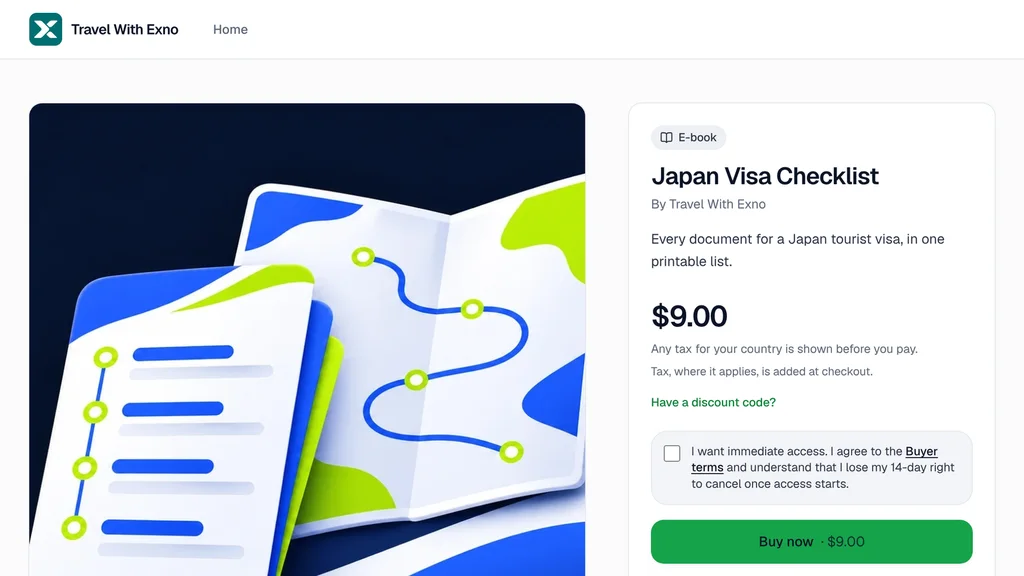
How to add a product to your EXNO store
Adding a product takes a few minutes: you create it, write the page buyers see, set a price, add a cover and the files buyers get, and publish. The clips below show every step in a real EXNO store, Travel With Exno, as it adds a Japan visa checklist.
Read the guide
Guide
Where should you sell your digital products?
The best platform to sell digital products depends on what you deliver, how buyers find it, and who should handle the transaction. Shortlist Etsy for original digital designs, Shopify for a shop that also ships goods, Gumroad for direct creator sales, and EXNO for a mixed digital catalog with a storefront and marketplace.
Read the guide
Guide
What to do when a buyer disputes a digital product sale
Chargebacks on digital products happen when a buyer disputes a card payment through their card issuer rather than simply requesting a refund. On EXNO, submit the evidence for each case through the Disputes page; EXNO adds the order records and handles the response, while the disputed sale’s earnings wait for a decision.
Read the guide