 Gumroad



 Polar
 Kelviq
 Stan

Selling guide
How to sell 3D model packs that survive a buyer’s first import
To sell 3D models, define the buyer’s use, test the exported asset in that environment, and package the geometry, textures, documentation and license together. Sell the result as a digital download on EXNO. A studio buying modular game scenery needs different evidence from a designer buying a still-render prop or a maker buying a printable part. 1678
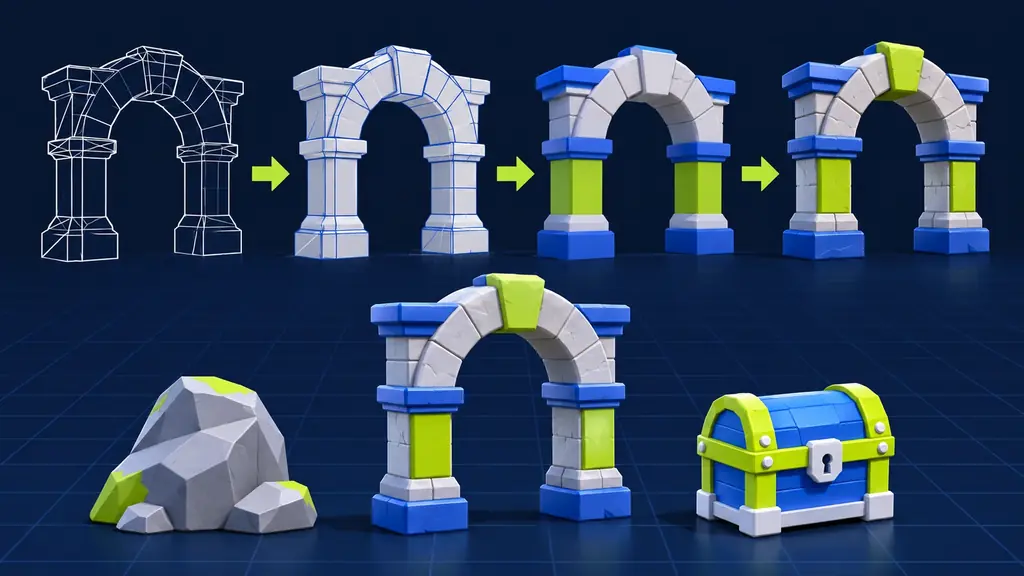
Which 3D asset are you selling, and for what use?
Choose the intended production task before promising a file package: a game prop, animated character, printable object and visualization model solve different problems. Describe the usable deliverable and its tested environment, not just the rendering in the preview; an attractive image does not establish animation, manufacturing or engine compatibility.
| Product | What to specify | Buyer-facing test |
|---|---|---|
| Static props or modular level pieces | Scale, pivots, collision and mesh detail levels. | Place pieces together and check alignment. |
| Rigged character | Skeleton, included animations and deformation limits. | Play representative poses and inspect joints. |
| Printable object | Dimensions and actual print preparation included. | Inspect geometry in the intended slicing workflow. |
| Visualization model | Materials, textures and tested renderer. | Reproduce the supplied scene without missing dependencies. |
Label optional source files separately from ready-to-import assets. Do not advertise the same export as game-ready, print-ready and renderer-ready unless each claim has its own verification.
How do you prepare a complete, testable asset package?
Export into a clean delivery folder, import that folder into a fresh target project and inspect geometry, materials and behavior without relying on your working environment. Record application versions and export settings, then document the remaining setup; file-format support is a starting point for testing, not proof that your entire asset works unchanged.
- Verify dimensions and pivots. Document units and orientation, check a known dimension after import and test modular snapping. glTF specifies meters and a positive Y up-axis; other pipelines need their own checks. 7
- Account for dependencies. Inspect UVs, the coordinates that map textures onto surfaces, and include required texture files with working paths. A GLB can reference external resources, so its extension alone does not prove everything is embedded. 7
- Measure each detail level. List triangle counts per level of detail (LOD), not one ambiguous polygon total. Check transitions and collision. Epic’s FBX pipeline uses 2020.2 and documents material-import limits; verify the maps and collision actually received. 8
- Test the intended behavior. For Unity, inspect model, rig, animation and material import settings as applicable. Record the version tested and disclose missing features instead of turning a successful mesh import into a blanket compatibility promise. 9
“The units for all linear distances are meters.”
Price the asset’s usable scope, not just its polygons
Separate a static prop, a modular collection, and a rigged edition by the work buyers can actually perform with each package. Price documented compatibility, useful assembly options, and permitted team use rather than implying that more polygons or a higher price guarantee production readiness.
These fictional packages assume you created the assets and control the necessary rights. Identify any third-party components separately; your license cannot expand their permissions.
Standard sales: 7%. Discover sales: 7%. Additional fees may apply to payment processing, payouts and other transactions. See the Seller Agreement for current fees and terms.
Define whether clients can receive source files and whether contractors need separate seats. Permit distribution inside finished projects only as your terms specify, not unrestricted resale of the assets. State what the rig supports and which updates are included.
How to launch your 3D asset pack on EXNO
Sell a defined asset pack with explicit formats, tested software, and usage rights, then verify that the purchased files import on a clean machine. Keep original turntable and wireframe previews public while delivering the versioned geometry, required maps, and license privately after payment.
- Define the edition. Identify the static OBJ or GLB package and any separately tested engine-specific edition. State included maps and intended uses. Compatibility with a tool does not grant commercial, redistribution, or other rights; the license must explain those permissions.
- Attach the private release. Use EXNO’s product presentation and private delivery to separate public previews from the geometry, maps, and matching license. Label the package version clearly. This delivers files, not engine hosting or copy prevention. 1
- Prove the checkout selection. Test the product’s payment link and confirm that the selected edition matches its description and deliverable. Complete an independent buyer-access check rather than relying on the seller preview. 1
- Import only the delivered package. On a clean setup, check scale, materials, and missing dependencies without your local paths. EXNO customer emails can communicate release corrections; keep each correction tied to an identifiable version. 1

Which previews tell a buyer the assets will fit a project?
Pair your polished render with a technical view that answers a buying question: show where modular walls snap, how a rig bends, or which texture maps reproduce the surface. Give the tested engine or renderer version and distinguish the components the buyer receives from lighting, staging or accessories used only for presentation.
Make one claim measurable
For a modular corridor, show three straight 2-meter segments snapped end to end. With no gap or overlap, the expected run is 6 meters. Include one corner piece, show its pivot and record whether the end snaps to the same grid after a quarter turn. This test says more about a building kit than a screenshot taken from an angle that hides the joins.
On EXNO’s Discover marketplace, put the main use and tested target near the title. Follow a short turnaround preview with a wireframe, a map inventory and that one demonstrable result. Say which objects are sold individually and which are included in the collection. 2
Catch common support problems before sending a replacement
- Missing surface: import from the delivered archive rather than the working directory. Look for absent images, absolute paths or an unsupported material node before re-exporting the whole mesh. 78
- Unexpected engine behavior: determine whether the buyer has the neutral exchange file or a documented engine package. Keep a small reference scene for the latter. Do not promise custom collision or animations you never shipped. 89
- Download complaint: identify the receipt and edition first. A missing purchase belongs in the EXNO buyer-access workflow; a missing normal map in an archive is a seller packaging issue. 5
“give appropriate credit”
CC BY 4.0 permits commercial sharing or adaptation subject to its conditions, including credit, a license link and notice of changes. Do not apply your own no-redistribution rule to a CC BY component. A noncommercial license does not authorize packaging that component for a commercial sale unless you obtain separate permission. 1011
Turn the shape of your kit into a small visual marker
A three-face cube is still legible when the surface detail of a model would disappear. A block on the EXNO Pixel Wall can use a simple original silhouette to point at your public turntable or listing, leaving the paid geometry and textures inside the purchased archive.
EXNO offers one million pixels at $1 each, with a title and optional URL for a selected block. Pay once by card or seller earnings; review takes place before the artwork goes on display. A visitor should not need a 3D viewer to recognize the design.

3D asset sales FAQ: formats, dependencies and permissions
Buyers use technical shorthand differently: one might say “source” and mean editable geometry, while another expects a complete project with its renderer settings. Use these answers to clarify the file, the environment and the rights separately before a customer mistakes an attractive preview for the exact contents of the download.
Should I offer FBX, glTF, GLB or the original project?
Offer the files you have tested for the advertised use. A glTF or FBX export serves an exchange workflow; the native project can expose different editing controls and dependencies. List it separately if included, and do not describe one interchange file as a tested project for several engines. 789
Does a GLB always have all its textures inside?
No. GLB can contain data internally, but the specification allows references to external resources. Move the release to a clean directory and inspect the imported materials without access to your source texture library; ship every permitted dependency the buyer needs. 7
What should I disclose before calling an asset game-ready?
State the engine and version tested, scale, mesh triangle counts, material or texture requirements, collision and any levels of detail supplied. A rigged product also needs skeleton and animation information. Report the results of your import; do not promise a frame rate across unspecified hardware and scenes. 89
Can an engine import file size stand in for a performance budget?
No. Archive size measures a different thing from rendering cost. Give the buyer usable details such as triangles per level of detail, texture dimensions, material count and whether the sample scene includes other objects. A meaningful runtime measurement also needs a stated scene, toolchain and device.
Can I sell screenshots, characters or objects copied from a game?
Do not package third-party material unless you have the rights needed for the specific distribution. Creating the mesh yourself does not settle rights in a recognizable protected character, branding or borrowed texture. Use original work or obtain the relevant permissions, and document any third-party components.
Can I include a Creative Commons texture in a model pack?
It depends on the exact license and your sale. CC BY 4.0 permits commercial reuse subject to its conditions; CC BY-NC 4.0 does not grant commercial use. Check whether other rights apply, keep attribution and license information with the asset, and do not promise exclusive rights over that texture. 1011
Does a rigged model include animations or a particular skeleton?
Not necessarily. State which skeleton and bind pose you supply, whether the mesh is weighted and which animation clips, if any, are included. To claim a particular engine setup, test the actual animations or poses in that setup rather than relying only on your authoring viewport. 79
Can a visualization model also be sold as print-ready?
Only advertise it for printing after separate preparation and verification. Check physical dimensions, closed geometry and the intended slicing workflow; disclose whether you inspected a slice or actually made a physical test print. A plausible render on a screen establishes none of those facts.
General information, not tax or legal advice.
Check the format, engine and license against their own sources
Khronos defines the glTF file format; Epic Games and Unity document their own import workflows, not blanket compatibility with every production tool. The Creative Commons deeds summarize permissions for two specific licenses, and EXNO describes the listing, checkout and payments behind the illustrative offers shown here.
- EXNO product and storefront features · Private digital file delivery, product editions, checkout links and storefront tools· checked 19 November 2026
- EXNO · The public marketplace where shoppers browse digital products by category· checked 19 November 2026
- EXNO seller pricing· checked 19 November 2026
- EXNO payments · The buyer transaction and EXNO’s merchant-of-record responsibilities· checked 19 November 2026
- EXNO Help Center · Seller and buyer workflows, including accessing purchased digital products· checked 19 November 2026
- EXNO guide to selling digital design assets · Store presentation, digital delivery and licensing for creator-owned asset packs· checked 19 November 2026
- Khronos: glTF 2.0 specification · Meter-based units, coordinate axes, buffers, images, skinning and the GLB binary container· checked 19 November 2026
- Epic Games: FBX static mesh pipeline · Version, UVs, collision and material-transfer limits for Unreal Engine static meshes· checked 19 November 2026
- Unity: importing a model · The editor’s import settings, asset inspection and distinction between project and source file· checked 19 November 2026
- Creative Commons: Attribution 4.0 · Commercial sharing and adaptation, attribution and the prohibition on additional restrictions· checked 19 November 2026
- Creative Commons: Attribution-NonCommercial 4.0 · The noncommercial condition and other permissions a creator may still need· checked 19 November 2026


Release the exported pack, not the authoring folder
Choose one target workflow, copy the exact deliverable to a clean project and record a test that another artist can repeat. When the import, contents and license match the public description, publish that edition through EXNO with a technical preview beside the finished render.
Keep reading

Selling guide
How to sell finished AI-assisted art without overstating the rights
To sell AI art, start with a finished visual product you created or have permission to sell, check the model and asset terms, and give buyers accurate files and usage terms. A customer purchasing a background set should know its pixel dimensions, what you edited, what they can use it for, and whether they are buying images or a tool that makes them.
Read the guide
Selling guide
How to package AI automation templates buyers can run themselves
To sell n8n templates, package an original workflow with its input format, setup instructions, a safe sample, and a result the buyer can check before enabling it. Make and Zapier use different ways to share automation, so sell the edition you actually tested. The buyer supplies their own authorized accounts and keys; the download is not a running service.
Read the guide
Selling guide
How to sell AI prompt packs that a buyer can actually test
To sell AI prompts, choose a task with a checkable result, package your reusable instructions with sample inputs and a review checklist, and sell the editable files as a digital download. Show buyers which model and interface you used, what they must provide themselves and how to tell when an answer is wrong. EXNO can deliver the kit after checkout; it does not supply the buyer’s AI account as part of that download.
Read the guide