 Gumroad



 Polar
 Kelviq
 Stan

Guide
How to sell digital products before you have your own website
You can sell digital products without a website by sending buyers to a hosted checkout, a storefront the selling platform provides, or a marketplace listing. Use a payment link for someone ready to buy, a storefront for someone comparing your offers, and a marketplace listing for someone searching by category. None requires you to build or maintain a separate site.

Should buyers see a checkout, a store, or a marketplace listing?
Choose the destination by what the buyer already knows, not by how many products you have made. Someone who has just watched a full demonstration may need only the correct offer and price, while someone who found you through a search still needs to work out what the product does.
| Route | Use it when… | What it cannot do for you |
|---|---|---|
| Direct payment link | A prospect asks how to buy the specific digital kit or consulting session you just discussed. | The link does not explain a complex offer by itself. Put the essential details beside it. |
| Hosted EXNO store | Visitors need to compare a full course, its standalone workbook, and a set of practice files. | You still have to show why the options differ and give people a reason to visit. |
| EXNO Discover listing | Someone searching for a product type could recognize the right result from a precise title and preview. | Being listed does not tell you how often the right shoppers will see or buy it. |
A fourth option is worth ruling out if you have nowhere to put it: an embedded EXNO checkout needs a page on your own site to hold the payment window. A hosted destination is a real web page, but you do not need to buy hosting, register a domain, or write code to send buyers there.
How do you set up a buyer-ready destination?
Start with one specific offer, give the buyer enough information to decide without messaging you, and connect that offer to the right checkout and delivery instructions. A page that clearly explains one download or one service is more useful than a full catalog that leaves the next step uncertain.
- Describe what changes hands. For a font, state the file types and usage rights. For a recorded class, show what someone will learn and what they need beforehand. For a bespoke service, say what the customer supplies, when work begins, what is delivered, and how revisions are handled.
- Choose the shortest usable route. With an EXNO payment link, you can sell without a store page and share checkout directly by email, message, or social media. If a buyer needs to inspect alternatives, use the store provided at yourname.exno.app instead. Its product pages follow your store theme.
- Put evidence before payment. Use the drag-and-drop Store Builder to place a gallery beside an explanation of variants. A pair of screenshots labeled “editable spreadsheet” and “printable PDF” helps buyers make a choice a decorative banner cannot. For one offer in a message, the equivalent may be a sample image and two sentences.
- Make the receipt useful after the conversation ends. Name the purchased item precisely and set the post-purchase message to explain the next step. Downloads are accessible from the buyer’s EXNO library. A service order needs instructions for the human handoff, not a suggestion that the work is already done.
Do not confuse a sample with delivery. Share a public preview on social channels and reserve the complete paid file for buyers. If a template needs an external application, say which one before checkout; if personal feedback costs extra, do not depict it as part of the basic version.
Where do you put the link so people can actually use it?
Put the destination where the purchase decision happens, label it with the product name and action, and open it from the same app and device your audience uses. A working address in a desktop browser does not prove that a caption, a forwarded message, or a small profile button is tappable.
- From a conversation: if someone requests the price of a private portfolio review, send the agreed scope and the offer in the same message. A descriptive label such as “Buy the 30-minute portfolio review” is clearer than “link.” W3C recommends making a link’s purpose clear from the words or their context.1
- From a social profile: use the hosted store if posts refer to different products over time. Mention the product name in the post so someone arriving later can still find it. On YouTube, URLs in Shorts descriptions and comments are not clickable; a channel profile link is a different placement. Check the actual channel’s options before writing “tap below.”2
- From an email: describe a single offer, show a genuine sample, and point to that offer rather than the top of a large catalog. Keep a copy of the final email and its destination; an old newsletter can continue circulating after you replace a product.
- From marketplace search: browse the EXNO Discover marketplace as a shopper. Use the relevant category and a title that distinguishes your format. “Editable editorial calendar” and “editorial calendar printable” do not promise the same thing.
Keep a link ledger. Record the placement, the words next to the link, its destination, and the date you last checked it. EXNO store addresses can be changed; do not assume that every old mention will still land where you intend. A shortlist of your public placements makes a change far less error-prone.
How do you test the route and decide whether it works?
Trace a real buyer’s path from the first mention to the correct product, checkout total, receipt, and promised delivery; then compare the results by channel. If visitors cannot find the right item, fix the destination before treating a quiet launch as evidence that the product itself is unwanted.
- Open it as a visitor. Use a phone on which you are not signed into the seller dashboard. Check that the link opens the intended offer, its currency is clear, and a buyer can see the format and limitations before choosing to pay.
- Read the first screen twice. First pretend the referring post is visible; then pretend a friend forwarded only the address. A draft title such as “Option B” fails the second test. Give the offer enough context to stand on its own.
- Separate traffic sources. Set consistent, nonpersonal campaign labels for a newsletter and a profile link; EXNO statistics show referrers and UTM campaigns. UTM source names the referring site, app, or list; medium describes the kind of traffic, such as email or social; campaign names the promotion. Those labels describe a route, not a buyer’s identity or a reason for buying.3
Compare equivalent numbers. Suppose you manually reconcile 90 visits and three orders attributed to a newsletter, versus 30 visits and two orders attributed to a profile, over the same period. That is about 3.3% versus 6.7%. The newsletter still had more orders, and one extra order would move the smaller group substantially. Treat this as an example of what to investigate, not a verdict about either channel.
Standard sales: 7%. Discover sales: 7%. Additional fees may apply to payment processing, payouts and other transactions. See the Seller Agreement for current fees and terms. EXNO handles applicable buyer transaction taxes, refunds and disputes as merchant of record. You supply accurate product details and the promised work.
A permanent address marker for a store without a separate site
Your hosted storefront may be represented by a short address in one place and a colored profile icon in another. On the EXNO Pixel Wall, you can give it a permanent rectangular marker with its own title, an image or solid color, and an optional destination link.
Pixels cost $1 each, and a rejected submission gets a full refund. If a small marker suits your store, the EXNO Pixel Wall is one way to support the platform; each design appears only after approval.

Common questions about selling without your own site
Selling without a separate website removes a hosting task, not the need for a clear offer and a reliable place to send customers. These questions cover the differences between a public listing and a private conversation, what a buyer can revisit, and when a larger website might earn its keep.
Can I sell just one download without designing a store?
Yes. A direct EXNO payment link takes someone to checkout without a store page; put the file format, price, license, and delivery details in the message or post that leads there.
Can I do this if I have no social following?
Yes, but you still need a route by which prospective buyers can find the offer. A relevant marketplace listing and a useful demonstration for an audience you have permission to address are two different starting points; neither ensures sales.
What if buyers lose the original post after buying?
They can use their receipt and, for downloadable purchases, their EXNO library rather than hunting through old social posts. If the offer includes personal work, state the contact route and next step in the purchase instructions too.
Should every link in my profile point straight to checkout?
No. For someone comparing formats or prices, the right first stop is a product page or store where those differences are visible. A direct checkout link makes more sense when the buyer already understands the offer.
When would a separate website be worth building?
Consider it when you need things beyond the buying route, such as a substantial editorial archive or a portfolio with complex navigation. You can decide that after learning which products and questions actually bring people to your hosted destination.
General information, not tax or legal advice.
Sources
These references describe how readers recognize link purpose, which YouTube placements allow clickable external links, and how campaign labels distinguish traffic sources. They support the placement and measurement checks above, not a claim that any particular channel will deliver a minimum audience, click rate, or number of orders.
- W3C: helping readers identify a link’s purpose from its label and context· checked 20 November 2026
- YouTube Help: where external links are clickable, including profile links and Shorts limitations· checked 20 November 2026
- Google Analytics Help: consistent UTM source, medium, and campaign labels· checked 20 November 2026


Give one buyer a clear path from interest to delivery
Choose the offer people already ask about and write down the few facts they need before spending money on it. Set up the destination that fits that decision, open it from the place you plan to share it, and make sure the buyer can recognize the same offer at every step.
Keep reading
Guide
How to add a product to your EXNO store
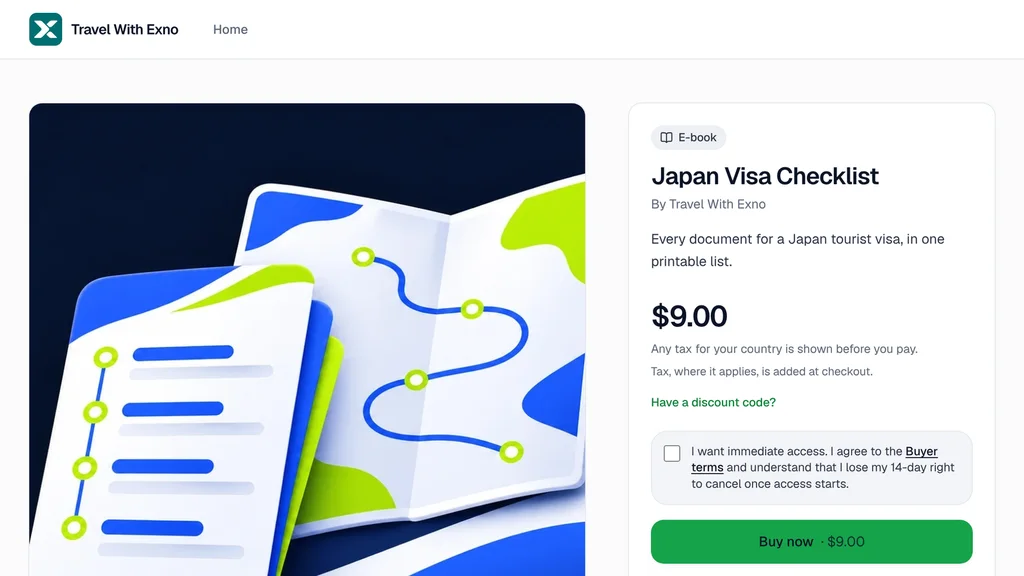
Adding a product takes a few minutes: you create it, write the page buyers see, set a price, add a cover and the files buyers get, and publish. The clips below show every step in a real EXNO store, Travel With Exno, as it adds a Japan visa checklist.
Read the guide
Guide
Where should you sell your digital products?
The best platform to sell digital products depends on what you deliver, how buyers find it, and who should handle the transaction. Shortlist Etsy for original digital designs, Shopify for a shop that also ships goods, Gumroad for direct creator sales, and EXNO for a mixed digital catalog with a storefront and marketplace.
Read the guide
Guide
What to do when a buyer disputes a digital product sale
Chargebacks on digital products happen when a buyer disputes a card payment through their card issuer rather than simply requesting a refund. On EXNO, submit the evidence for each case through the Disputes page; EXNO adds the order records and handles the response, while the disputed sale’s earnings wait for a decision.
Read the guide