 Gumroad



 Polar
 Kelviq
 Stan

Selling guide
Sell a craft pattern that helps makers choose the right size before they begin
To sell sewing patterns online, supply original instructions, correctly scaled pattern pieces and enough sizing information for a maker to decide before cutting fabric. For knitting and crochet, replace the paper-scale test with a tested gauge, stitch instructions and finished measurements. On EXNO, sell the digital pattern, not the sample garment, fabric, yarn or finished object in the photos. 16789
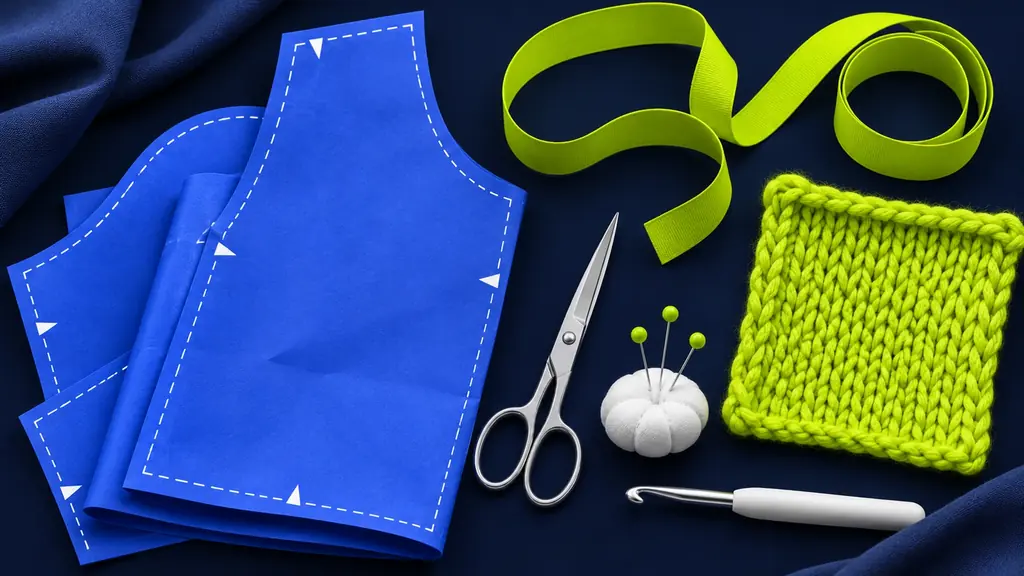
Which pattern package can a maker confidently choose and use?
Sell instructions for a defined project, with the sizing, materials and file formats a maker needs to decide whether it suits them. A graded sewing pattern, a knitted garment and a crochet accessory require different checks; a photograph of your finished sample cannot substitute for those specifications.
| Project | Useful files | Decision before purchase |
|---|---|---|
| Graded sewn garment | Tiled home-print PDF, assembly map and separately labeled large-sheet file. | Size range, fabric requirements and supported paper sizes. |
| Knitted garment or accessory | Written instructions, schematic and size-specific counts. | Finished dimensions, gauge and required techniques. |
| Crochet project | Written rounds or rows, with a chart if included. | Terminology system, construction and materials. |
These are illustrative packages. Separate body measurements from finished measurements and explain intended ease, rather than letting a size label promise fit. Disclose which sizes were actually tested and which were graded but not made up. 8
How do you test the instructions rather than just the sample?
Ask a tester to work from the exported files without relying on your verbal explanations, then record every correction before release. Check the printed scale or stitched gauge first, because clear diagrams and attractive styling cannot rescue inaccurate dimensions, missing pieces or instructions that silently change terminology halfway through.
- Proof the sewing files. State whether seam allowances are included and their widths, list pattern pieces and cutting quantities, and check tile joins. Print and measure the test square before assembling everything, as Seamwork recommends for its PDFs. 7
- Specify the swatch. Give stitch and row gauge, stitch pattern, measurement area and blocking method, plus needle or hook sizes in millimeters. List tested yarn and fiber composition; do not assume another fiber in the same weight category behaves identically. 911
- Reconcile the instructions. Label US or UK crochet terminology and define special abbreviations. Check written counts against charts and repeat boundaries for each offered size. 10
“Always follow the gauge stated in your pattern.”
Price the tested instructions, not the maker’s body size
Base a pattern’s price on tested instructions, clear grading, useful formats, and the support you can provide, not on charging larger bodies more. Show the full included size range before purchase and distinguish a maker’s copy from permission to reproduce your written materials for a class.
These fictional offers assume original, rights-cleared patterns. They illustrate packaging, not market averages or unverified claims about testing.
| Edition | Price | Files, testing, and rights |
|---|---|---|
| Single-size crochet accessory | $9 | Tested instructions, stitch glossary, and dimensions; one maker’s copy, no PDF redistribution. |
| Multi-size sewing garment | $16 | Tested instructions, graded pattern files, and measurement chart; every advertised size included at the same price. |
| Knitting teaching edition | $30 | Written lesson materials expressly licensed for one instructor to distribute to ten enrolled learners; no public upload. |
State the tested size range, printing formats, skill prerequisites, and correction policy. Classroom copying permission concerns the written files; address selling finished items separately rather than treating permission for one as permission for the other.
Standard sales: 7%. Discover sales: 7%. Additional fees may apply to payment processing, payouts and other transactions. See the Seller Agreement for current fees and terms.
How to launch your sewing, knitting, or crochet pattern on EXNO
List the pattern as an English-language digital product, identifying its size range, skill level, and included PDF formats before checkout. Deliver the correct files with a version and errata route, then verify the buyer’s downloaded instructions using the relevant print-scale or gauge check rather than the listing preview alone.
- Show what the pattern covers. Preview the size range, required skills, and a sample diagram without publishing the complete paid instructions. State that the purchase supplies a pattern, not a finished garment, yarn, or other shipped materials.
- Attach the right PDF set. Use EXNO’s digital-product presentation and private delivery for the labeled release. Distinguish screen-reading files from home-printing or other supplied formats; identify supported paper sizes and include versioned instructions. 1
- Check purchase and access. Test the pattern’s purchase link, inspect the receipt, and retrieve the files as a buyer. Confirm the delivered set matches the selected edition rather than an incomplete sample. 1
- Perform the relevant check. Measure the printed actual-size test square for sewing patterns, or follow the stated gauge check for knitting and crochet. Verify diagram labels and the errata contact against the downloaded release.
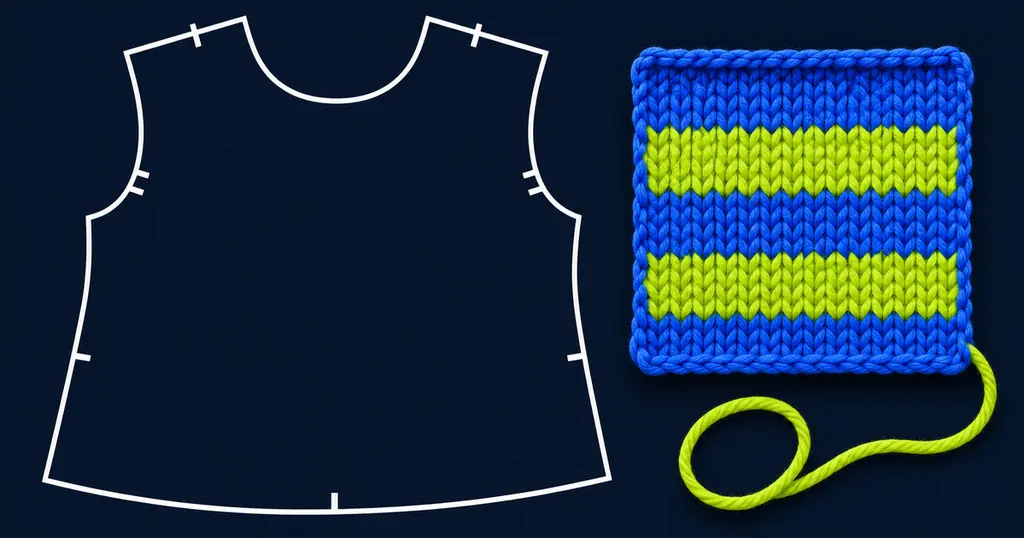
What proof helps a maker decide whether the pattern fits?
Show one finished sample with its size, actual measurements, material and intended fit; add a small part of the instructions that demonstrates the level of guidance. Buyers should be able to judge sizing and difficulty before they buy, and to recognize a scale or gauge problem before committing their materials.
Make the effect of gauge visible
Suppose a straight, unshaped panel uses 96 stitches and the design gauge is 20 stitches per 10 cm. Its expected width is 48 cm. At 24 stitches per 10 cm, the same count gives 40 cm, an 8 cm difference. Those figures assume the same stitch pattern and measurement conditions; they are not the circumference of a whole garment. Ask makers to measure a representative washed or blocked swatch as specified by your pattern. 911
For sizing, a 96 cm body measurement and a 104 cm finished chest give 8 cm of positive ease. For a sewing pattern, explain whether that finished measurement excludes seam allowances and follows the stitching line. A clear diagram and actual numbers in a Discover listing serve the maker better than promising a perfect fit. 28
Help the buyer identify where the project went wrong
- Paper pieces are too small: start with one test page at actual size. A 100 mm square measuring 97 mm indicates a scale problem; do not cut the garment or manually enlarge individual pieces to compensate. 7
- Stitch counts diverge: check the pattern version, size column, turning chain and repeat boundaries. An original count such as 6 repeats of 4 stitches plus 2 edge stitches should total 26 before any shaping.
- Instructions did not arrive: use the buyer’s receipt and EXNO’s help with purchased downloads for access. If the file opens but contains a wrong chart, issue a dated correction describing exactly which row or size changed. 5
“may protect the way these things are expressed”
Use original text, illustrations, diagrams and photos or obtain permission to distribute them. Describing a familiar stitch in your own pattern is different from copying another designer’s chart or photography. Classroom copying of your PDF and sale of an item made from it are also different questions. 12
Turn a stitch repeat into a signpost for your pattern catalog
A tiny arrangement of knit-like loops or alternating blocks reads more clearly than a full garment squeezed into a thumbnail. If you use the EXNO Pixel Wall, link an original motif to a public pattern page with the size chart and sample photos rather than giving away the cutting sheets.
There are one million squares, priced individually at $1. A block may have a title and a destination; payment comes once from a card or seller earnings. EXNO reviews the submission before display, so share release-day instructions separately.

Pattern-selling FAQ: print scale, gauge, sizes and teaching copies
A maker may not discover a missing seam allowance or an unexpected stitch convention until fabric has been cut or hours of work have been completed. Use these answers to make high-cost mistakes visible early and to distinguish an access problem from an error in the instructions themselves.
What does a buyer get when I sell a sewing pattern online?
List the actual PDFs: instructions, size chart and the cutting sheets you tested for home or copyshop printing. Identify any supplies, fabric or notions the maker must obtain separately. A photo of a finished sample does not mean the garment is included. 17
Can I call a sewing PDF print-at-home if it only works on A0 paper?
No. A single large-format sheet is a copyshop deliverable, not automatically a set of home-printer tiles. If you offer A4, US Letter or both, test the announced layouts, margins, page order and join marks on those paper sizes. 7
How should I explain seam allowances and finished measurements?
State whether the sewing pieces include a seam allowance and give its width, noting any exceptions such as a different hem allowance. A finished garment measurement should describe the sewn item; tell the maker how much ease it has against the stated body measurement. 8
Is using the recommended yarn weight enough to match the sample?
No. Yarn weight is a starting point; tension, construction, fiber, tool and stitch pattern can change the result. State the tested gauge and swatch conditions, the yarn length required for each size and a way to check fabric behavior before beginning. 911
Do U.S. and British crochet instructions use the same stitch names?
Not always. A U.S. single crochet corresponds to a U.K. double crochet, while a U.S. double crochet is a U.K. treble. Label the convention at the start of the instructions and define any special stitch or chart symbol you use. 10
Can I say every size was test-made if I graded the whole range?
No. Grading creates the other sizes; it does not prove someone made each one. Identify the range you drafted, the sizes you physically tested and what was technically checked. Label sample photos with the size made and finished measurements.
Can a teacher give every student a copy of one purchased pattern?
Only when the applicable permissions cover that use. If you sell a class license for your own material, state the number of copies or participants, whether digital sharing is permitted and whether access lasts for one class or several. Do not confuse teaching copies with the right to make or sell finished objects.
What should I do after finding a mistake in one pattern size?
Identify the version, size and precise line or piece affected. Retest the corrected instruction, update the errata and label replacement files clearly; a correction to size M should not cause everyone to guess which instructions changed. Keep the prior edition identifiable for support.
General information, not tax or legal advice.
Pattern-making references and digital sale terms
Seamwork documents its own PDF print workflow; the Craft Yarn Council explains gauge, equipment, sizing and crochet terminology; and the United States Copyright Office distinguishes expression from methods. The pattern examples here are original, not copied patterns, and EXNO’s references cover the digital purchase rather than physical supplies or workmanship.
- EXNO product and storefront features · Private digital file delivery, product editions, checkout links and storefront tools· checked 19 November 2026
- EXNO · The public marketplace where shoppers browse digital products by category· checked 19 November 2026
- EXNO seller pricing· checked 19 November 2026
- EXNO payments · The buyer transaction and EXNO’s merchant-of-record responsibilities· checked 19 November 2026
- EXNO Help Center · Seller and buyer workflows, including accessing purchased digital products· checked 19 November 2026
- EXNO: preparing downloadable templates · Separating preview and paid files, help notes and versioned delivery· checked 19 November 2026
- Seamwork: download and print PDF patterns · Example of a pattern publisher testing tiled print files, layers and actual-size printing· checked 19 November 2026
- Craft Yarn Council: body measurements and sizing · Body measures, finished garment measurements and ease· checked 19 November 2026
- Craft Yarn Council: hooks and needles · Millimeter sizing and checking individual tension with a gauge swatch· checked 19 November 2026
- Craft Yarn Council: crochet abbreviations · U.S. crochet terminology and comparison with British equivalents· checked 19 November 2026
- Craft Yarn Council: standard yarn weights · Yarn weight categories and illustrative gauge ranges, not a substitute for the actual design gauge· checked 19 November 2026
- U.S. Copyright Office: works not protected by copyright · Ideas, methods and systems are distinct from original expression in text or illustrations· checked 19 November 2026


Publish the design after a maker can follow it without you
Read the final files in the order a new maker will use them, check scale or gauge and follow the most error-prone repeat before opening the listing. When the tested sizes, materials and deliverables match the preview, put your original pattern on EXNO with a clear support and corrections policy.
Keep reading

Selling guide
How to sell 3D model packs that survive a buyer’s first import
To sell 3D models, define the buyer’s use, test the exported asset in that environment, and package the geometry, textures, documentation and license together. Sell the result as a digital download on EXNO. A studio buying modular game scenery needs different evidence from a designer buying a still-render prop or a maker buying a printable part.
Read the guide
Selling guide
How to sell finished AI-assisted art without overstating the rights
To sell AI art, start with a finished visual product you created or have permission to sell, check the model and asset terms, and give buyers accurate files and usage terms. A customer purchasing a background set should know its pixel dimensions, what you edited, what they can use it for, and whether they are buying images or a tool that makes them.
Read the guide
Selling guide
How to package AI automation templates buyers can run themselves
To sell n8n templates, package an original workflow with its input format, setup instructions, a safe sample, and a result the buyer can check before enabling it. Make and Zapier use different ways to share automation, so sell the edition you actually tested. The buyer supplies their own authorized accounts and keys; the download is not a running service.
Read the guide