 Gumroad



 Polar
 Kelviq
 Stan

Guide
Make an ebook readers can open, navigate, and use
If you’re learning how to create an ebook, start with a reader and one clear promise, write and edit the manuscript, then choose the format that serves it. Prepare the cover and chapter navigation, export a clean edition, and test the actual download outside your writing app before you release it.

What belongs in the manuscript before you start formatting?
Define one reader, the question that brought them to the book, and what they should be able to do or recognize by the end. Draft the smallest complete route between those points, with an example where the reader needs one and a way to find the relevant chapter again.
Suppose the working title is A Field Guide to Photographing Pottery. “Learn photography” can grow indefinitely; “make three pictures of a mug that show its shape, glaze, and scale using a phone and a window” gives the author and reader the same finish line. A camera history can wait. A picture showing where to put the mug relative to the window earns its place.
- Write the one-paragraph brief. Name the reader’s starting equipment or knowledge, the promised result, what you will not cover, and how the reader can check their work. For narrative nonfiction or fiction, substitute the central question or story arc for the practical result.
- Outline by reader questions. Turn “lighting” into “Why does this glaze look flat?” Sketch the example and the change the reader will make. If two chapters answer the same question, combine them or make the difference explicit.
- Draft a complete sample chapter. Include its hardest image, longest caption, and one cross-reference. Work out the pattern here before multiplying a layout or tone problem across a whole manuscript.
- Edit in two passes. First move, cut, and fill gaps in the argument. Then correct wording, terminology, units, figure references, and links. Give a new reader the instructions without explaining them aloud; a question they must ask is often a sentence you need to write.
Keep a source and rights log beside the draft
For each photograph, illustration, quotation, and font, note who supplied it, which uses you have permission for, and any credit it requires. A license to use a picture in a slide presentation is not evidence that it covers a book cover. Replace material whose permitted use you cannot establish, and keep the permission with the editable manuscript rather than inside a folder of delivery files.
Should you make an EPUB, a PDF, or both?
Choose reflowable EPUB when the main job is continuous reading at a size the reader controls, and PDF when the position of words or objects on a page matters to the task. Offer both only if you can maintain, label, and proof two genuinely useful editions of the same work.124
| What the reader does | Format to try | Proof that matters |
|---|---|---|
| Reads a novel, essay, or long explanation on a small screen | Reflowable EPUB | Enlarge the type; headings, notes, and captions should still appear in the right sequence. Refer to a chapter or figure, not “the next page.” |
| Prints a worksheet or follows a page-sized pattern | PDF with an intentional page size | Print the page at the scale you specify. Check the edges, writing room, and any printed reference measure. |
| Reads instruction on a phone, then works on paper | EPUB book plus a separate printable PDF | Name which file to read and which to print. Verify that the exercise numbers agree across the pair. |
| Needs a composition that has meaning only in its exact arrangement | Consider a fixed-layout edition | Test reading order, visibility, and an equivalent way to understand essential visual information. Fixed positioning introduces accessibility challenges.2 |
Work from paragraph and heading styles, not tabs, blank lines, or spaces used to force text into position. Use real numbered lists, descriptive link labels, and a caption associated with its image. If a diagram explains the entire example, describe its meaningful relationships in the text; “diagram of pottery” does not tell the reader where the light came from.123
Make a deliberate choice about wide tables. A six-column lighting comparison might become three small examples with the same labels, rather than tiny type that forces the reader to pan. In a tagged PDF, verify the reading and keyboard order independently of visual position; a sidebar that looks separate can interrupt a sentence when read aloud.4
How do you turn an edited draft into a finished book?
Give the book a cover that remains recognizable as a thumbnail, establish a consistent chapter hierarchy, and export from an editable master rather than from an earlier delivery file. The finished package should identify the work and its author, open in a sensible place, and let a reader navigate without guessing.
- Design at two sizes. Give the title visual priority, then check the cover at the size of a small bookshop thumbnail. In the pottery example, a single recognizable mug can do more than a contact sheet of twenty images. Keep the author name and title identical on the cover, title page, and in the file metadata.
- Build navigation. Use a title page, a linked table of contents, a clear heading for each chapter, and credits or references where appropriate. In EPUB, the navigation document and the spine have different jobs: one helps readers jump to a section, the other supplies the default reading sequence. Check both.1
- Prepare illustrations for reading. Crop for the point being made, not simply to fit the editor window. Keep text labels legible on a phone, describe meaningful details, and retain original image files for later corrections. Do not turn pages of ordinary prose into pictures of text.3
- Export with an edition identifier. Keep the working title, revision, and date in a release note. Use buyer-facing names such as Pottery-Photos-v1.epub and Pottery-Setup-Sheet-v1.pdf. Keep the editable layout, high-resolution originals, permission evidence, and working notes out of the customer download.
Open the result outside your authoring program. Some defects belong to the source and will survive every export: a heading that was only made larger, a caption referring to a deleted figure, or an image with an old credit line. Fix those defects in the master and export again so a later edition does not bring them back.
How do you prove the files are ready for a reader?
Use two kinds of proof: run the file through an appropriate technical check, then ask a person to perform ordinary reading tasks on the exported copy. A file can pass EPUB validation while still containing an unreadable diagram, a confusing chapter title, or instructions that point to the wrong worksheet.5
- Inspect the file structure. Run EPUBCheck on your final EPUB and investigate reported errors or warnings. It checks conformance to EPUB specifications, not whether a chapter teaches what you promised. For the PDF, inspect the tags, reading order, navigation, and selectable text.45
- Try three routes. Open at the beginning, jump straight to a middle chapter from the contents, and follow a note or figure reference back to its context. Repeat with enlarged type in a reading app, and check the printable pages on paper. Record the precise file version you tested.
- Do a blind handoff. Give a tester only the delivery files and a task, such as “find the setup for glossy glaze and print the matching sheet.” If the tester opens the wrong file, change the names or instructions rather than assuming readers will know your process.
If the print companion depends on physical scale, add a labeled reference line to the sheet. For example, a 100 mm line that measures 96 mm on paper is 4% short. Check the print scaling setting before changing the master, then measure a second print. For an ordinary writing worksheet, a comfortable writing area may matter more than exact scale.
Once the files pass, keep selling choices separate from editorial work. The guide to selling ebooks covers the offer; the guide to digital delivery covers the handoff. On EXNO the reader can return to purchased downloads in their library. Show a real interior page in the Store Builder gallery rather than making the cover carry every detail.
In the email template editor, preview the delivery message with its first instruction written for a reader, not a file manager: “Open the EPUB to read; print the PDF when you reach the lighting exercise.” Put version labels in the files themselves so the instruction still makes sense after a reader saves the downloads elsewhere.
If your publishing imprint uses its own email address, connect it so delivery and receipt messages come from the name the reader saw on the book. That helps distinguish the message from unrelated mail; it does not replace checking that the attachment names, cover, and storefront all describe the same edition.
A tiny bookplate for your finished edition
An author’s bookplate can be as simple as an open book, a studio initial, or the shape readers remember from a cover. The EXNO Pixel Wall gives that small mark a permanent rectangle with a title, so the tribute can identify an edition even when its cover changes later.
Choose a spot for your bookplate on the EXNO Pixel Wall if you want to support EXNO’s growth; a space appears after approval.
Frequently asked questions
Production questions often arise after the manuscript feels finished, when a reader opens the book in a different app or tries to print a single page. These answers distinguish editorial choices from file requirements so you can fix the right problem without redesigning the entire book.
Do I need special software to write an ebook?
Use a writing tool that lets you preserve a clear heading structure and keep an editable master. The export tool is a separate choice: verify that it produces the format you intend to deliver and that you can inspect the result.
How long should my ebook be?
There is no page target for the manuscript in this workflow. Stop when the reader can complete the promised task or reach the intended ending without a missing step. Reflowable text makes page counts dependent on reading settings.1
Is converting a PDF to EPUB good enough?
Not by itself. Check whether headings, chapter order, captions, and linked notes survived the conversion. When possible, produce both files from the structured manuscript rather than reconstructing that structure from a finished page.
Can an ebook contain printable worksheets?
Yes. If writing space or exact scale matters, supply the worksheet as a print-tested PDF and refer to its filename and exercise number in the book. That leaves a phone reader free to enlarge the prose without distorting the worksheet.
General information, not tax or legal advice.
Sources
The publishing specifications below describe EPUB structure and accessibility, while the PDF technique deals with reading order and EPUBCheck tests technical conformance. The sample brief, cover test, and blind handoff are practical editorial exercises; they do not certify that an edition meets a particular accessibility standard.
- W3C: EPUB structure, reading order, navigation, and layout· checked 20 November 2026
- W3C: accessibility challenges and approaches for fixed-layout EPUB· checked 20 November 2026
- W3C: EPUB accessibility requirements and discoverability· checked 20 November 2026
- W3C WAI: checking PDF tab and reading order· checked 20 November 2026
- W3C and DAISY Consortium: what EPUBCheck validates· checked 20 November 2026


Give one reader the actual edition
Save the exact files that passed your proof, including the cover, and hand them to someone who has never seen the manuscript. When that reader can find a chapter, understand the illustrations, and open the companion material without a private explanation, you have a release worth listing.
Keep reading
Guide
How to add a product to your EXNO store
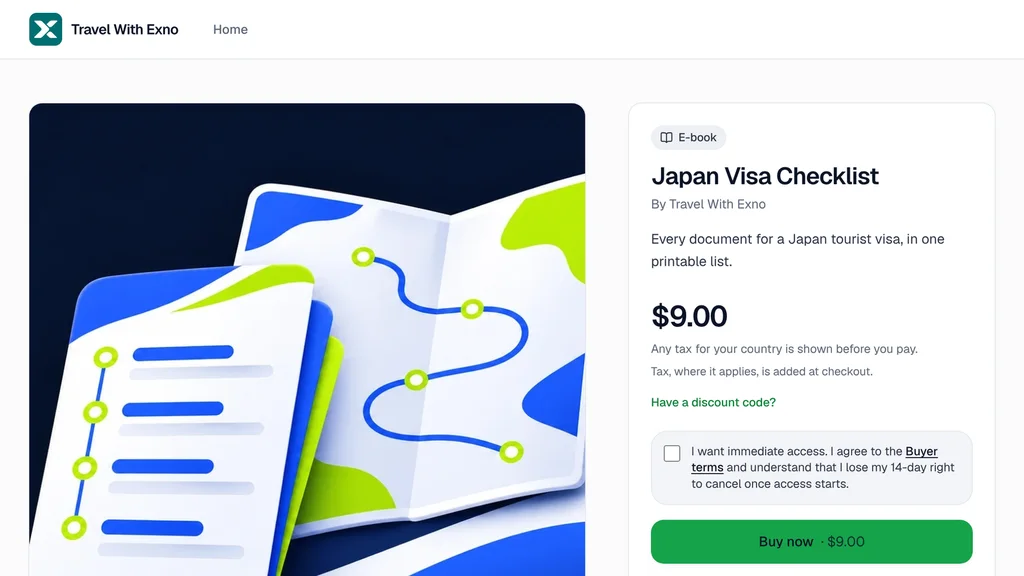
Adding a product takes a few minutes: you create it, write the page buyers see, set a price, add a cover and the files buyers get, and publish. The clips below show every step in a real EXNO store, Travel With Exno, as it adds a Japan visa checklist.
Read the guide
Guide
Where should you sell your digital products?
The best platform to sell digital products depends on what you deliver, how buyers find it, and who should handle the transaction. Shortlist Etsy for original digital designs, Shopify for a shop that also ships goods, Gumroad for direct creator sales, and EXNO for a mixed digital catalog with a storefront and marketplace.
Read the guide
Guide
What to do when a buyer disputes a digital product sale
Chargebacks on digital products happen when a buyer disputes a card payment through their card issuer rather than simply requesting a refund. On EXNO, submit the evidence for each case through the Disputes page; EXNO adds the order records and handles the response, while the disputed sale’s earnings wait for a decision.
Read the guide