 Gumroad



 Polar
 Kelviq
 Stan

Guide
Can a digital product keep earning after you make it?
Passive income with digital products is possible when different buyers can use the same work without asking you to make it again. Delivery can happen while you are away; demand, support, and upkeep still need your attention. Start with the work you can remove from each order, then check whether enough orders would pay for the work that remains.

Which products can you sell repeatedly without repeating the work?
Look for something that solves the same problem for different people, works in a predictable setting, and does not depend on your judgment after each sale. The most useful question is not which format is popular, but what the next buyer will need from you that the previous buyer did not.
| Offer | What the next buyer can reuse | What you still need to do |
|---|---|---|
| An undated planning workbook | The same blank pages and worked example | Check print sizes and explain which fields are editable. |
| A set of original sound effects | The recordings, filenames, and usage notes | Explain which uses are permitted and what the preview includes. |
| A spreadsheet or software extension | The formulas or code that complete a repeatable task | Test changes in the host application and describe compatible versions. |
| A recorded workshop versus a private consultation | The recording and exercises, not an individual assessment of a buyer’s problem | Correct outdated lessons; reserve calendar time for any private sessions you sell. |
Try the week-away test. Imagine you will not answer a message for a week. Which buyer can still get exactly what the listing promises? If a buyer needs you to customize a file, review their draft, or approve every step, that part of the sale is a service. Price and schedule it as such rather than hiding it inside the download.
How do you test an idea before building a catalog?
Start with a task someone already performs, find out what they use today, and put one usable sample in their hands before building variations. An enthusiastic response to a concept tells you less than watching a prospective buyer try that sample on the problem you say it solves.
- Find the current workaround. Ask a potential buyer to show how they did the task last time. For a budget worksheet, what did they enter twice? For a sound library, what was hard to find? Compare the alternatives they actually use, including free ones. Demand and existing alternatives are separate research questions.1
- Give them a small, finished result. Offer a working tab, an exercise, or a labeled set of sample sounds. Give a task, not a tour. If someone cannot tell which file to open, fix the package before adding more content.
- Draw a boundary around the offer. Write down the outcome, prerequisites, what support covers, and what requires a separate engagement. A planner can help organize appointments; it does not include reorganizing a buyer’s calendar for them.
- Check the rights behind every copy. Verify the permissions for material you did not create, including bundled fonts, artwork, and audio. Finding a work online does not by itself make it free to redistribute. Save the license or authorization alongside the release it covers.3
Choose one way to reach the buyers you spoke with. A useful demonstration shows the task being completed with your product, not the size of your catalog. Record what happens next: interest, a purchase, a recurring question, or no response. Each calls for a different decision.
How many sales would pay back your time and costs?
Calculate two numbers: the sales needed to recover your cash outlay and the sales needed to compensate your time at a rate you choose. For either estimate, divide the fixed amount you want to recover by what each sale contributes after variable costs, then round up to a whole order.2
Illustration, not a sales forecast. Suppose a digital kit sells for $24. You spend $84 preparing it and estimate $3 of selling costs per completed order. The $3 is an assumption for this exercise, not an EXNO fee quote.
- Cash only: $24 minus $3 leaves $21 per order. Four orders cover the $84 outlay exactly. They have not paid you for creating or supporting the kit.
- Include your time: at a planning rate of $20 per hour, 12 hours to build the kit adds $240. Your target becomes $324, and each sale contributes $19 toward it. Seventeen orders cover $323; it takes 18 to pass the target.
- Add an update: a two-hour compatibility fix adds $40 of your time, taking the target to $364. At the same $19 per order, it now takes 20 orders, not 18. If the fix recurs every month, budget it every month.
The exercise estimates whether the offer is worth your time; it does not tell you how to record that time for tax purposes. If variable costs use up all your proceeds from each sale, selling more at the same price cannot recover the fixed work. Reduce the work, change the price, or walk away.

What can EXNO handle, and what stays on your calendar?
Use EXNO for the sale and buyer access, and keep responsibility for finding customers, maintaining a usable product, and answering product questions. Build a short routine around what went wrong for actual buyers rather than spending every week adding more files that nobody has asked for.
Make delivery explain itself. In the Builder’s email template editor, preview the delivery message with the product name, the first file to open, and where to get help. For a multiformat kit, name the editable file and the read-only example separately. Buyers can return to downloads in their EXNO library.
Use a monthly work log. Put product views, checkout opens, sales, and earnings from EXNO statistics next to your own hours spent updating, promoting, and helping. A product with sales but repeated setup questions may need a clearer first step. One with almost no views has not yet told you much about its price.
Use the current terms in your calculation. Standard sales: 7%. Discover sales: 7%. Additional fees may apply to payment processing, payouts and other transactions. See the Seller Agreement for current fees and terms. Replace hypothetical selling-cost inputs in your worksheet with the terms applicable to your account.
Choose a review date for each offer. Keep a steady seller if it is still usable and the time makes sense; revise a frequently misunderstood one; retire an obsolete edition from new promotion while honoring what previous buyers purchased. The digital product license guide can help you clarify what buyers may keep using.
A small marker for the work behind a finished product
A finished product can look effortless to someone who never saw the early drafts, test orders, or fixes behind it. A permanent square of color on the EXNO Pixel Wall can mark the point at which you decided the work was ready to stand on its own.
If you want to support EXNO, choose a rectangle on the shared pixel wall at $1 per pixel and add a title, an image or color, and an optional link. EXNO reviews each submission and refunds the full payment if it is not approved.

Questions about income from repeat digital sales
The important distinction is between being free from one task, such as sending a file, and being free from all work on a business. These answers address what you can sensibly measure at the beginning, when it is worth making a change, and why regular sales do not make every product low maintenance.
How much can a beginner earn from digital products?
There is no reliable amount to put in a plan before you know your own demand, selling costs, and support workload. Work out what one order leaves you, then model a period with no sales as well as a period with some.
Do I need a large audience to test the idea?
No. A small group of people who already face the problem can spot a bad assumption before you commit to a large release. Positive feedback from that group is not a forecast of wider demand.
Is recurring revenue more passive than a one-time sale?
Not necessarily: a membership that promises new material every month creates a recurring production obligation. Compare that commitment with the support and occasional updates for a standalone product before choosing a subscription.
What if the first version takes too much support?
Count requests by the step where the buyer got stuck, not just by the total number of emails. If several buyers stumble over the same import dialog, a screenshot beside that step may be more useful than an expanded general FAQ.
Does calling the income passive determine its tax treatment?
No classification is being made here: “passive” describes how much work another sale takes in this guide. Keep the income and expense records you need and check the rules that apply to your own situation before filing.
General information, not tax or legal advice.
Sources
The business planning sources explain how to investigate demand and calculate a break-even point; the copyright reference distinguishes public availability from permission to use protected work. The example prices, support minutes, and update hours in this guide are inputs to a worksheet, not reported results from sellers.
- Small Business Administration: demand research, alternatives, and conversations with potential buyers· checked 20 November 2026
- Small Business Administration: fixed costs, variable costs, and the break-even formula· checked 20 November 2026
- World Intellectual Property Organization: permission, licensing, and works found online· checked 20 November 2026


Build one offer that can work without a personal handoff
Write the buyer’s first task on one line, test whether a stranger can finish it, and calculate the minimum number of sales that would make the work worthwhile to you. If those checks support the idea, a single clear listing is enough to start learning from real orders.
Keep reading
Guide
How to add a product to your EXNO store
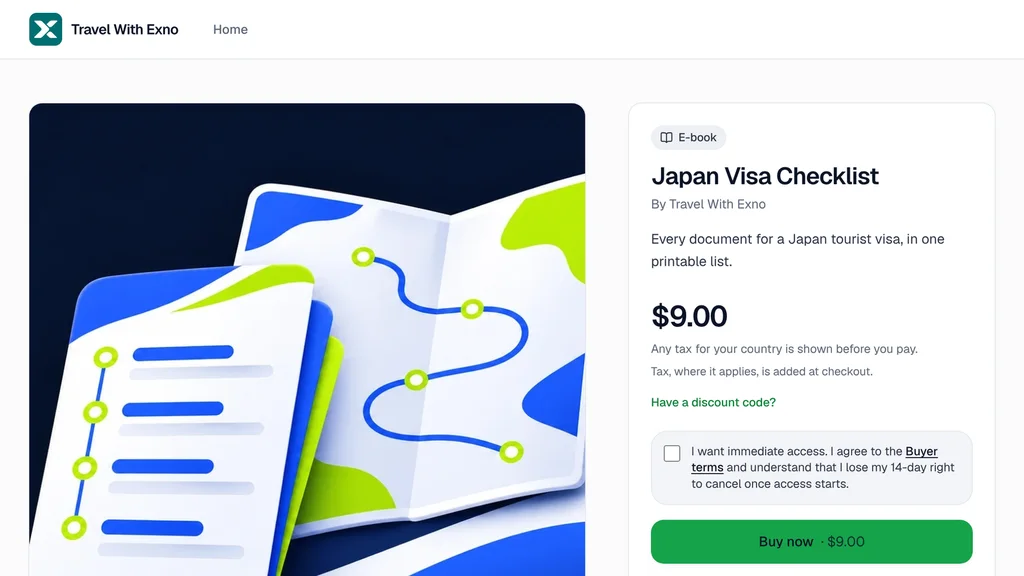
Adding a product takes a few minutes: you create it, write the page buyers see, set a price, add a cover and the files buyers get, and publish. The clips below show every step in a real EXNO store, Travel With Exno, as it adds a Japan visa checklist.
Read the guide
Guide
Where should you sell your digital products?
The best platform to sell digital products depends on what you deliver, how buyers find it, and who should handle the transaction. Shortlist Etsy for original digital designs, Shopify for a shop that also ships goods, Gumroad for direct creator sales, and EXNO for a mixed digital catalog with a storefront and marketplace.
Read the guide
Guide
What to do when a buyer disputes a digital product sale
Chargebacks on digital products happen when a buyer disputes a card payment through their card issuer rather than simply requesting a refund. On EXNO, submit the evidence for each case through the Disputes page; EXNO adds the order records and handles the response, while the disputed sale’s earnings wait for a decision.
Read the guide