 Gumroad



 Polar
 Kelviq
 Stan

Selling guide
How to sell sheet music that arrives ready for rehearsal
To sell sheet music online, clear the rights to the piece and your edition, then offer a readable score with the parts and copy permissions your buyer needs. A quartet director should know before paying whether the download contains a study score, four playable parts, or both. Start with one complete edition, not an entire back catalog.
Do you have the rights to sell this edition?
Check the composition, the particular arrangement, the lyrics, and any recording or artwork you plan to include, even when you own the notation file. Start with original work you control, material you have verified is in the public domain where you sell it, or permission covering the edition and the way you will distribute it.123
| Source of the piece | What to check | Record to keep |
|---|---|---|
| Your original work | Did a co-writer contribute lyrics? Has a publisher or commissioning agreement already taken rights you need? Do you control the recording used for the demo?23 | Contributors, contracts, credits, permitted uses, and your dated notation source. |
| A public-domain composition | Check the underlying work in the territories where you will offer it. A recent arrangement, added lyrics, or original editorial material can carry separate rights.124 | Identify the exact source edition and document why the underlying work and any material you use are cleared. |
| Another writer’s protected song | Ask the relevant rights holder about arranging the piece, reproducing it, and selling downloadable sheet music. Permission to perform it is not the same as authority to print and sell it.13 | The grant identifying the work, versions, formats, territory, duration, sales terms, and any required notices. |
If a choir director requests a popular song, do not take the request as clearance. Send the publisher a precise description: arrangement for which voices, score and parts, download or print, example excerpts, and intended territories. If the answer covers only a performance or never arrives, hold the listing. Credit acknowledges the writer; it does not replace permission.123
What should go in the player’s download?
Put the files on a music stand before deciding they are finished: supply a print-ready PDF with the edition name and instrumentation, plus individual parts if promised. Include a short contents page identifying every file, the notation conventions, and the permitted copies so a rehearsal leader does not have to guess.
- Make a file manifest. For an original string trio, that might be one full score and three named parts: violin, viola, and cello. Say whether the listed page count refers to the full score or all four PDFs together. Offer Letter and A4 only if you have checked both.
- Rehearse the awkward bars. Start at a rehearsal mark in the middle of the piece. Can all players find it, including a part resting across several measures? Check repeats, endings, pickup measures, page turns, and any transposing instruments. A clean full score can hide a collision or bad turn in one part.
- Distinguish fixed layout from editable notation. Use PDF as the print reference. Only promise MusicXML if it is part of the offer and the rights permit editing. Reopen it in the notation software you name and check the result; an interchange file can preserve notes but change line breaks, fonts, or spacing.5
- Make the preview representative. Show a few systems from a passage players will actually encounter, and name the hardest demand in plain language. A cover and a page of rests tell a conductor little about range, rhythmic complexity, or texture. Use only excerpts you may display.13
How should you price a solo copy or an ensemble set?
Price the edition and the permission you actually deliver: a solo PDF for personal use and a full rehearsal set for an ensemble solve different problems, even if the music lasts the same number of minutes. Identify what can be printed, by whom, and how many copies are included before setting the price.
Illustrative offers, not market rates: an $8 solo edition might permit one buyer’s personal print copy. A $24 trio set might include the full score and one copy for each of three players in a named ensemble. A teacher edition might allow a stated number of student copies for a stated period. Only offer a use you are entitled to grant; clarify whether public performance or recording is separate.12
Show the permission summary where someone chooses the edition, not just inside the ZIP. Describe whether duplicating a lost part, keeping a rehearsal copy on a tablet, or sharing a part with a substitute is covered. Send unusual uses to a contact form instead of promising every possible use. The guide to digital product licenses explains what to put in a buyer-facing rights summary.
EXNO is the merchant of record for applicable sale taxes, refunds, and payment disputes; eligible earnings go to your bank on Tuesdays. Any arrangement royalty you owe is a separate cost.
How do you list the edition and help the right players find it?
Organize the listing around the musician choosing repertoire: instrumentation first, then level, duration, what files arrive, and what the purchase permits, then build the checkout for that precise edition. A shopper who needs four playable parts should not have to pay first to learn that the listing was for a study score.
- Choose a searchable title. Give the piece, instrumentation, and edition a distinct name. Separate original and arranged works in your store navigation if you sell both. Show the cover, a score excerpt, and one actual player part in the Store Builder gallery.
- Put the edition where it is sold. In the product description, state page count, instrumentation, keys as relevant, approximate performance time, PDF paper sizes, and the allowed copy count. Upload the licensed files; EXNO supports up to 5 GB per file. Product pages inherit your store’s theme.
- Test the route from checkout to stand. Use Checkout Builder’s product-specific design to repeat the edition name. On the post-purchase page, identify the score and parts by filename. On a phone, open the delivery instructions; on a computer, unzip the purchased files and print the busiest page at actual size.
- Give each edition its own destination. If a chamber ensemble asks about the parts, share the payment link for the complete set, not a general catalog. In Discover, describe the particular ensemble and piece so that a visitor who did not see your original post can still choose.
Watch which listings draw views and which reach checkout. If a score attracts visitors but the parts listing gets repeated questions, fix the instrumentation or license description before lowering the price. Date substantial corrections and name the affected measure rather than quietly calling every download “final.”
A little mark for a finished edition
A score’s last proof often ends with an unglamorous detail: the title now fits, the parts agree, or a player finally has room to turn the page. A small space on the EXNO Pixel Wall can mark the edition as finished with a color, image, title, and optional link.
Pixels are $1 each and an approved space stays on the wall. To support EXNO, choose a rectangle for your edition’s mark.
Frequently asked questions
Before releasing a score, check the difference between a file you can open and a use you can authorize. These answers address the decisions that tend to surface after a musician asks to print extra parts, edit the score, or hear a recorded example before buying.
Can I sell an arrangement I wrote by ear?
Making the notation yourself does not settle rights in the underlying song. If it is protected, check the arrangement and distribution permissions or a valid legal exception before selling the file.12
Can I use an existing recording as my score preview?
Clear the recording and the underlying music for the intended preview. Even a short excerpt is not automatically free to use, and owning the sheet music is not the same as owning recorded audio.3
Does every buyer need an editable file?
No. A player may only need a stable print layout. If an editable file is offered, list its format, the software used to test it, and the modifications the buyer may make.5
What if I find an error after sending a set?
Identify the edition, part, measure, correction, and revision date. Check the same passage in the other parts and score, and tell affected buyers which file to replace rather than asking them to reprint the entire set blindly.
General information, not tax or legal advice.
Sources
These references distinguish composition rights, arrangement rights, and recorded audio, while the software documentation explains why an editable export needs its own check. Copyright exceptions, license terms, and protection periods can differ across territories; no reference below grants permission to use a particular song, edition, or performance.
- WIPO: the Berne Convention’s separate arrangements, reproduction, and performance rights· checked 20 November 2026
- WIPO: permission, copyright duration, online works, and national exceptions· checked 20 November 2026
- U.S. Copyright Office: composition, recording, and licensing distinctions· checked 20 November 2026
- U.S. Copyright Office: new expression in arrangements and editorial revisions· checked 20 November 2026
- MuseScore Studio: what may change when opening MusicXML in another program· checked 20 November 2026


Release one edition you would take to a rehearsal
Pick one piece, clear its sources, and print the full score and every part. Once a musician who was not involved in preparing the files can find the right entrance, read the terms, and identify the edition without asking you, the listing has something concrete to promise.
Keep reading
Selling guide
How to sell 3D model packs that survive a buyer’s first import
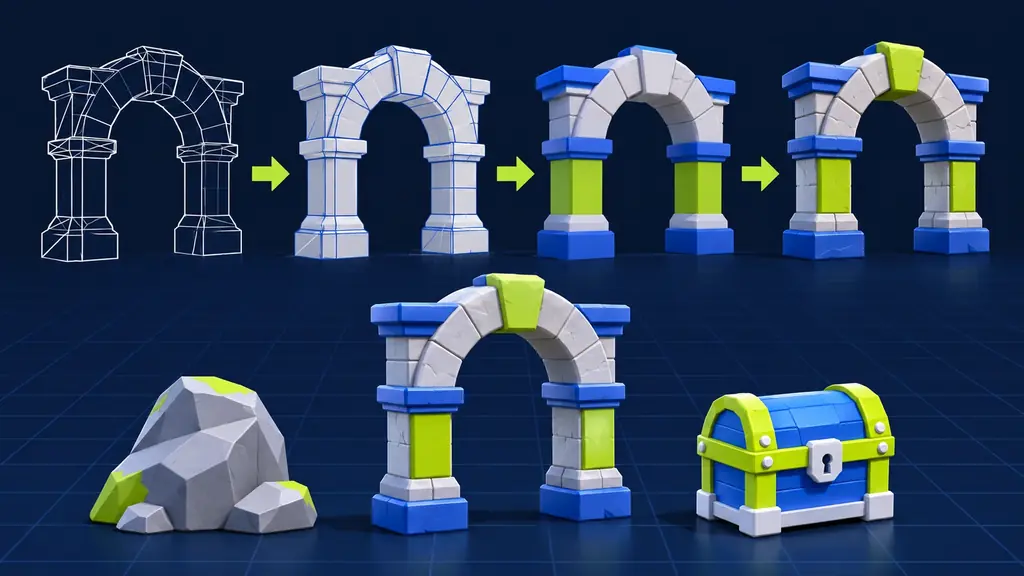
To sell 3D models, define the buyer’s use, test the exported asset in that environment, and package the geometry, textures, documentation and license together. Sell the result as a digital download on EXNO. A studio buying modular game scenery needs different evidence from a designer buying a still-render prop or a maker buying a printable part.
Read the guide
Selling guide
How to sell finished AI-assisted art without overstating the rights
To sell AI art, start with a finished visual product you created or have permission to sell, check the model and asset terms, and give buyers accurate files and usage terms. A customer purchasing a background set should know its pixel dimensions, what you edited, what they can use it for, and whether they are buying images or a tool that makes them.
Read the guide
Selling guide
How to package AI automation templates buyers can run themselves
To sell n8n templates, package an original workflow with its input format, setup instructions, a safe sample, and a result the buyer can check before enabling it. Make and Zapier use different ways to share automation, so sell the edition you actually tested. The buyer supplies their own authorized accounts and keys; the download is not a running service.
Read the guide