 Gumroad



 Polar
 Kelviq
 Stan

Guide
Which UK VAT treatment fits the digital product you sell?
UK VAT on digital products depends on what is supplied, where the customer belongs, whether they buy as a consumer or a business, and who makes the sale. A qualifying text ebook can be zero-rated while the audiobook version is standard-rated. For a sale through EXNO checkout, EXNO handles applicable buyer transaction tax as merchant of record; the creator still needs to describe the offer accurately and account for separate business obligations. 78101116

Distinguish automated delivery from a person delivering the service
UK VAT on digital products starts with the actual supply, not the fact that a customer pays online. For consumer sales, distinguish automatically delivered content from live human services, then establish the customer’s location and status before deciding which place-of-supply and VAT treatment questions need to be answered.
This guide uses UK guidance checked on November 19, 2026. HMRC describes electronically supplied services as automated delivery with minimal or no human intervention; a teacher delivering a webinar is different from automated learning. Neither the word course nor the use of video settles that classification. 7
| Offer | Fact to record | Question requiring review |
|---|---|---|
| Self-paced automated lessons | How content and assessment are delivered | Does the electronically supplied service rule apply? |
| Live tutor session | Who teaches and what the session covers | Which service rules and any education relief apply? |
| Download plus personal critique | What the recording and human work each provide | Is this a single supply or multiple supplies? |
Live teaching is not automatically exempt: HMRC’s education notice sets conditions concerning the provider and the supply, including particular private-tuition rules. Business-to-business transactions also need a separate assessment under the place-of-supply rules rather than borrowing the consumer answer. 911
“Automated learning does not have human involvement and is therefore a digital service.”
An EXNO listing can offer hosted lessons or downloadable files. If you also supply individual tuition or feedback, describe it separately and retain the description with the version sold; a checkout label cannot classify the service for VAT. 4
Check whether the content qualifies as an electronic publication
A qualifying electronic publication can be zero-rated without every downloadable file receiving the same treatment. Examine the substance of the publication, including its audio, video, advertising and interactive components, instead of assuming that a PDF extension, an educational topic or the word ebook determines the VAT rate.
HMRC’s electronic-publications guidance distinguishes readable or viewable qualifying books from audiobooks, which remain standard-rated. It also says a publication more than half devoted to advertising, audio or video is standard-rated, and reading software is not itself an electronic publication. Those distinctions matter when a text edition becomes a multimedia package. 8
For sales through EXNO, the EXNO payments explanation describes its merchant-of-record role. Provide accurate product facts for that checkout relationship, while keeping your own business obligations and sales elsewhere separate; platform tax handling does not turn a standard-rated item into a zero-rated publication or decide your personal tax position. 16
Identify whether the quoted price already includes VAT
A £120 price produces different arithmetic depending on whether VAT is included, added afterward, or charged at zero because the supply qualifies for zero-rating. Establish the item’s treatment and the price basis first, then use the actual buyer invoice to reconcile tax rather than treating every digital product as standard-rated.
These illustrations assume a UK supply with the stated classification already established. They ignore other charges and do not represent actual purchases, a ruling on your product, or an assumption about the platform’s fee base.810
| Price and established treatment | Value excluding VAT | VAT | Value including VAT |
|---|---|---|---|
| £120 inclusive, standard-rated at 20% | £100.00 | £20.00 | £120.00 |
| £120 exclusive, standard-rated at 20% | £120.00 | £24.00 | £144.00 |
| £120 qualifying zero-rated e-book | £120.00 | £0.00 | £120.00 |
For the inclusive price, divide £120 by 1.2 to find £100 before VAT; subtracting gives £20 VAT. Taking 20% of the inclusive £120 would incorrectly produce £24. That £24 is correct only when £120 is the VAT-exclusive base, giving a £144 total.10
The e-book example assumes it meets the electronic-publication zero-rating conditions. Zero-rated means a taxable supply at 0%, not an exempt supply. Do not apply that label to every PDF, audiobook, software product, or mixed bundle merely because it is delivered electronically.8
VAT collected is not creator income, and the invoice total is not a bank payout. See the Seller Agreement for EXNO fees and terms; do not infer a commission base from this tax table. The actual buyer invoice and applicable tax treatment are decisive for reconciliation; investigate any mismatch rather than forcing the receipt into an illustrative row. 12
How do customer status and location change the analysis?
Determine whether the customer is buying as a business or a consumer, then apply the relevant place-of-supply rule to the actual service. The buyer’s location and the seller’s establishment answer different questions; neither a UK business address nor an overseas payment automatically establishes the VAT treatment of every digital sale.
For B2B treatment under Notice 741A, obtain commercial evidence of business status and, where relevant, that the customer belongs outside the UK. HMRC describes an EU VAT number as the best evidence for an EU business customer but allows appropriate alternatives, including fiscal certificates or commercial documents. A business buying wholly for private purposes falls under B2C rules. 11
“Such evidence should be kept as part of your records.”
For consumer digital services covered by HMRC’s digital-services guidance, establish where the consumer normally resides, subject to the applicable presumptions and evidence rules. For example, an automated download supplied to a consumer who normally lives in the UK falls within UK VAT, with the appropriate rate for the item. The equivalent supply to a consumer who normally lives outside the UK is not liable to UK VAT under that rule, but may be taxed where that customer lives. 7
Do not generalize that rule to every service delivered over the internet. Identify what is actually supplied before choosing the rule, and distinguish the consumer transaction from any separate supply by a creator to a platform. When records conflict, resolve the classification and location question rather than selecting the answer that produces the lowest tax.

When does a platform account for the customer’s VAT?
Check who supplies the customer under the actual arrangements, rather than assuming every platform or payment processor takes over VAT. EXNO states that it acts as merchant of record for purchases through its checkout, but that role does not settle the creator’s separate supplies, income taxes, or transactions completed through other channels.
HMRC’s consumer e-services guidance makes the platform responsible unless all the stated conditions hold: contractual arrangements identify the supplier; invoices, bills, or receipts identify that supplier and service; and the platform does not authorize the charge, authorize delivery, or set the sale’s general terms. Merely naming the creator is insufficient when those conditions fail. Processing payments alone does not make a provider the deemed platform supplier. 7
For an EXNO purchase, its merchant-of-record role covers the customer transaction and applicable transaction-tax handling. An EXNO checkout embedded on the creator’s website remains that checkout; an unrelated payment route on the same site is not covered merely by proximity. Review the actual contract and transaction records rather than treating the website’s branding as the tax analysis. 16
Retain the receipt, product description, amounts charged, and later adjustments. Where you have your own VAT obligations, maintain the appropriate records and distinguish sales, platform charges, and payouts instead of recording only a bank deposit. HMRC’s charging and recording guidance is relevant to those obligations, not a promise that every creator must register. 10
EXNO’s refund policy explains its handling of refunded customer tax. Match the refund to the original transaction and use the EXNO Help Center for missing records or an unclear charge. Ask HMRC or a qualified adviser about your own registration or supply to the platform; support cannot determine worldwide filing obligations from a receipt alone. 35
Use a receipt motif without implying tax certification
A small receipt illustration with separate net and tax panels can make the topic recognizable without displaying a real customer’s information. Place it on the EXNO Pixel Wall only as optional promotion, not as a valid VAT invoice, an HMRC endorsement or proof of a product’s tax treatment.
The grid has one million cells at $1 each, with a single payment for your block by card or EXNO earnings. Submit original artwork for review and approval; adding a title and URL is optional. Keep the destination a public page rather than a private invoice.

Questions about UK classification, customers and checkout
Two products delivered through the same email or storefront can still require different VAT analysis, especially when one includes a live service or a qualifying publication. These answers address common classification mistakes within the UK scope, while leaving individual registration, exemption and cross-border determinations to the relevant guidance and qualified advice.
Does selling something online make it an electronically supplied service?
No: the delivery and level of human involvement matter, not just the payment method. HMRC distinguishes automated learning from a service delivered by a person online. Describe what actually happens after purchase before selecting a tax category. 7
Is a live coaching or teaching call automatically VAT-exempt?
No: falling outside the electronically supplied definition is not the same as qualifying for exemption. Education relief has conditions, and a coaching label does not establish that they are satisfied. Check the actual provider, subject and supply rather than equating human involvement with exemption. 79
Does the consumer guidance also settle sales to businesses?
No: establish whether the customer is acting as a business and review the applicable business-to-business rules separately. HMRC’s place-of-supply notice explains the general rules and exceptions. A company name entered during checkout should not replace the evidence needed for the particular transaction. 11
Are all ebooks and downloadable workbooks zero-rated?
No: qualifying electronic publications receive specific treatment, not every file sold under that label. HMRC also addresses publications predominantly intended for completion, with stated exceptions. Assess the actual content and function rather than assuming a planner, form or workbook qualifies because it is a PDF. 8
Can an audiobook use the readable ebook’s VAT treatment?
Not merely because both editions contain the same story. HMRC says audiobooks remain standard-rated, while its electronic-publication relief covers qualifying books that can be read or looked at. Assess a mixed text-and-audio offer on its actual composition rather than automatically inheriting the text edition’s treatment. 8
Does zero-rated mean the same thing as exempt?
No: zero-rated supplies are taxable supplies charged at zero, while exempt supplies are a different category. That distinction can affect matters such as registration and input-tax recovery. Use the relevant rules for your business rather than treating both labels as interchangeable ways to say no tax appears on the sale. 10
Does EXNO handling checkout VAT remove my other tax obligations?
No: its merchant-of-record role concerns purchases through its checkout. Your own business records, income taxes and other selling arrangements still need appropriate review. Describe the product accurately and keep the platform relationship distinct from your overall tax position. 16
What if a buyer disputes the VAT shown on an EXNO receipt?
Refer the order to EXNO support with the relevant product and transaction details, rather than promising a separate refund yourself. Explain the issue without sharing the receipt publicly or collecting unnecessary private information. A support review is not automatic confirmation of an exemption or an approved reimbursement. 35
General information, not tax or legal advice.
UK guidance for the supply, rate and selling relationship
HMRC’s digital-service, electronic-publication, education and place-of-supply guidance addresses different questions and should be read together where an offer combines them. Its VAT charging guidance distinguishes tax treatments; EXNO’s sources explain the platform relationship and support process, not a universal exemption or a determination of an individual seller’s obligations.
- EXNO: payment responsibilities · Who handles the buyer transaction through EXNO checkout· checked 19 November 2026
- EXNO: pricing· checked 19 November 2026
- EXNO Help Center· checked 19 November 2026
- EXNO product features · Accurate product offers and buyer-facing delivery information· checked 19 November 2026
- EXNO refund policy · Handling transaction refunds at EXNO checkout· checked 19 November 2026
- EXNO: merchant of record · The platform’s role for its own checkout and the creator’s separate responsibilities· checked 19 November 2026
- HMRC: digital services supplied to private consumers · Consumer location, automated supplies and the conditions for a platform to avoid being treated as supplier· checked 19 November 2026
- HMRC: zero rating for electronic publications · Qualifying publications and exceptions including predominantly audio, video or advertising· checked 19 November 2026
- HMRC: education and vocational training, Notice 701/30 · Provider and subject conditions, including private tuition; course titles are not enough· checked 19 November 2026
- HMRC: charging and recording VAT · Standard rate and calculating inclusive versus exclusive prices· checked 19 November 2026
- HMRC: place of supply of services, Notice 741A · General business versus consumer rules, evidence and exceptions· checked 19 November 2026


Prepare the product facts before opening checkout
Describe whether the buyer receives automated content, a qualifying publication, software or a service delivered by a person, and record any bundled components. Keep that description consistent across the listing and delivery, so the checkout relationship can be reviewed without relying on a broad label such as digital or educational.
Keep reading
Guide
How to add a product to your EXNO store
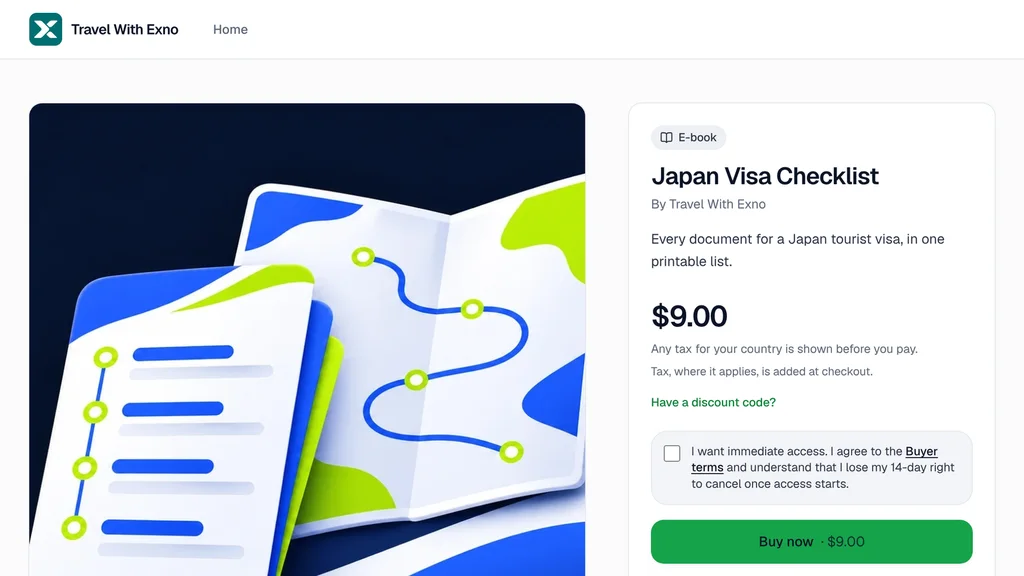
Adding a product takes a few minutes: you create it, write the page buyers see, set a price, add a cover and the files buyers get, and publish. The clips below show every step in a real EXNO store, Travel With Exno, as it adds a Japan visa checklist.
Read the guide
Guide
Where should you sell your digital products?
The best platform to sell digital products depends on what you deliver, how buyers find it, and who should handle the transaction. Shortlist Etsy for original digital designs, Shopify for a shop that also ships goods, Gumroad for direct creator sales, and EXNO for a mixed digital catalog with a storefront and marketplace.
Read the guide
Guide
What to do when a buyer disputes a digital product sale
Chargebacks on digital products happen when a buyer disputes a card payment through their card issuer rather than simply requesting a refund. On EXNO, submit the evidence for each case through the Disputes page; EXNO adds the order records and handles the response, while the disputed sale’s earnings wait for a decision.
Read the guide