 Gumroad



 Polar
 Kelviq
 Stan

Guide
Do U.S. buyers owe sales tax on your digital product?
Sales tax on digital products in the United States depends on what the buyer receives, where the sale is sourced, and which state rules apply on the transaction date. A downloadable book, a prewritten software subscription and a package containing a printed copy can have different outcomes. EXNO handles applicable transaction tax on purchases through its checkout; your own sales elsewhere and your business’s other obligations remain separate. 7891116
Classify the actual product before looking for a rate
Sales tax on digital products depends on what the customer receives, where the transaction is sourced and which rules apply on the sale date. A downloadable book, remotely accessed software and a human-delivered service can have different treatment, even when the same storefront sells all three through similar checkout pages.
Describe the substance: a static reading file, an executable tool, ongoing database access or personal advice. Record physical extras, included services and updates rather than assigning every online sale to a generic digital category. The following contrasts illustrate why classification matters; they are not a complete state taxability chart.
- California, current treatment. Publication 109 generally treats electronic transmission of products such as software, ebooks and images as nontaxable, but adding a printed copy or physical backup usually makes the entire sale taxable. Read this alongside the enacted future software change, not as timeless advice. 78
- Washington. Digital goods generally fall within sales or use tax, including electronically delivered books, subject to exclusions and exemptions. Software has its own classification; calling everything a digital good can obscure the applicable rule. 9
- New York. Prewritten software is taxable regardless of delivery method, including remote access. Its ebook policy is narrower: all specified conditions must be satisfied, not merely a PDF filename or a book-shaped cover. 1112
“It does not matter if the purchaser obtains a permanent or nonpermanent right of use.”
When you list the item, describe what the customer actually receives: a hosted course, a one-time file or recurring access. EXNO supports several product formats, but choosing one in the storefront is not a state tax ruling. 4
Separate an enacted change from a rule already in force
A tax rule can be enacted without applying to today’s sale, so save both the source date and the effective date in your product review. California’s announced software expansion illustrates that distinction: prepare for the change while keeping current transactions separate from the rules scheduled for the following year.
As of November 19, 2026, California SB 122 is enacted but its relevant expansion begins January 1, 2027. CDTFA’s September notice covers prewritten software supplied physically, electronically or remotely, including prewritten SaaS; ebooks and specified audio, audiovisual and visual works are outside this new definition. It also lists exemptions, so the headline is not a rule taxing every digital purchase. 8
Next identify who sells the transaction and what remains your responsibility. The EXNO payments explanation describes its merchant-of-record role for purchases through EXNO; that is distinct from your direct sales elsewhere, business records and personal or business income-tax obligations. Do not turn checkout tax handling into a promise that every state registration or filing question disappears. 16
Separate the taxable amount from the creator’s earnings
Calculate sales tax only after determining whether the specific item and transaction are taxable, then keep that collected amount separate from product revenue and platform fees. A rate example can explain the arithmetic, but it cannot decide a real buyer’s jurisdiction, establish an exemption, or substitute for the applicable classification rules.
The table uses a fictional combined state-and-local rate of 6.5%, not the rate of any identified jurisdiction. It assumes a $75 tax-exclusive product price, no other taxable charges, and rounding to the nearest cent for this illustration. No actual sale or tax determination is represented.
| Assumed classification | Product price | Tax collected | Product plus tax |
|---|---|---|---|
| Taxable at the fictional 6.5% combined rate | $75.00 | $4.88 | $79.88 |
| Item established as not taxable for this transaction | $75.00 | $0.00 | $75.00 |
| Valid applicable exemption established and documented | $75.00 | $0.00 | $75.00 |
For the first row, $75 × 6.5% = $4.875, rounded here to $4.88. The resulting $79.88 comprises $75 of product value and $4.88 collected from the buyer for tax remittance. It is not $79.88 of creator earnings. Actual checkout totals can also include separate charges omitted from this example.
The two zero-tax rows have different reasons. An item outside the applicable taxable category is not the same as a taxable item sold under a valid exemption. Preserve the classification or exemption evidence rather than entering zero solely because the buyer requests it.
See the Seller Agreement for EXNO fees and terms, separately from this assumed tax calculation. Reconcile receipts, tax records, refunds and settlement statements; a refund can reverse collected tax as well as product value. A checkout total or tax example does not establish the amount reaching the creator’s bank. 12
How are nexus and the location of a sale different?
Nexus asks whether a business has a sufficient connection to a state for particular tax obligations, while sourcing determines where a transaction belongs under that state’s rules. Neither question alone decides whether a digital product is taxable, and a remote-sales threshold is not a nationwide exemption from registration, reporting, or income taxes.
Washington illustrates the distinction. Its remote-seller guidance uses more than $100,000 in combined gross receipts sourced or attributed to Washington in the current or prior year. The measure includes otherwise exempt receipts and marketplace sales, not only taxable sales made through a seller’s own checkout. Physical-presence nexus is a separate consideration; being below this economic threshold is not a complete answer for a business with a physical connection to the state. 10
Washington’s digital-product guidance separately applies a sourcing hierarchy. Receipt at the seller’s business location and, otherwise, the location where the purchaser receives the product are among its steps. Do not substitute the seller’s home address, a platform’s headquarters, or a generic “online” label for the applicable sourcing analysis. Classification and any exemption still need their own review. 9
“The tax results of other situations must be determined separately after review of all the facts and circumstances.”
Use this example as a reason to maintain channel and location records, not as a rule to copy into every state. Sales-tax collection and the seller’s income-tax or other business-tax obligations are different questions.
What remains the seller’s responsibility when EXNO handles checkout tax?
EXNO handles customer transaction tax for purchases completed through its checkout as merchant of record, but that does not settle every obligation of the creator’s business. Track other selling channels, retain the records behind each transaction, and evaluate your own reporting and income taxes separately instead of treating a payout as a tax-clearance certificate.
The checkout used matters more than where its button appears. An EXNO checkout embedded on your website remains an EXNO transaction; an unrelated checkout on the same website does not become covered merely because another page uses EXNO. Identify the actual merchant and transaction route for each sale before describing who handles customer tax. 16
Retain the original sale, product and edition, buyer-location evidence available through the appropriate records, tax charged, refunds, and amounts remitted to you. Keep sensitive buyer information in authorized systems rather than duplicating it in public reports. Reconcile refunded orders against the originals instead of deleting them from the record of what occurred. EXNO’s refund policy explains when its refunds include transaction tax. 5
Other-channel receipts may matter even when another party collected the customer’s tax. Washington’s remote-seller calculation includes marketplace receipts, and its guidance distinguishes collection from potential B&O reporting. Do not assume EXNO’s commercial label alone resolves how a state classifies your contractual relationship; use the actual arrangements when obtaining jurisdiction-specific advice. 10
For a missing transaction record or an unclear checkout charge, use the EXNO Help Center. For registration, nexus, or your own return, consult the relevant authority or a qualified adviser. Platform support can clarify a purchase record without determining every tax obligation of your business. 3
Keep promotional space separate from tax documentation
Three colored panels can stand for the information missing from a tax rate alone: the item, the place and the date. The EXNO Pixel Wall can carry that illustration as a pointer to your shop, not as an official tax map, calculator or government endorsement.
A six-by-six design occupies 36 of the million available pixels. At one dollar per pixel its placement costs $36 once; use a card or eligible EXNO earnings. Submit the design for approval. An optional title and link can identify the storefront without revealing a buyer’s invoice.

Questions that a single nationwide answer cannot resolve
A seller may need different answers for product classification, the location of use, collection responsibility and the date a new law starts. These questions focus on those distinctions using selected state guidance, rather than offering a nationwide rate, a personal filing determination or a guarantee that every digital purchase is taxable.
Are digital downloads always taxable in the United States?
No single rule covers every state and product. California’s electronic-delivery guidance, Washington’s digital-products rules and New York’s distinction between prewritten software and qualifying ebooks illustrate different approaches. Check the actual supply and applicable date rather than relying on the word download. 7891112
Does California’s 2027 change already apply in November 2026?
No: CDTFA identifies January 1, 2027 as the start of the relevant expansion. The law is enacted, but its future effective date should not be treated as the current rule on November 19, 2026. Review transition details for transactions spanning the change instead of assuming which date controls. 8
Will that California change tax every ebook or video?
That is not what the cited notice says. Its new digital-product definition concerns prewritten software, and it specifically excludes digital books and specified audio, audiovisual and visual works from that definition. Other facts and rules still matter, so this is not a blanket exemption for every mixed package. 8
Is every PDF treated as an ebook in New York?
No: the memo requires all its conditions, including a single download, ebook marketing, no entitlement to additional goods or services, and restricted revisions. It also limits software functionality and the frequency of editions where periodic updates are customary, and excludes packages containing prewritten software or other tangible personal property. Apply the complete memo rather than a file-extension shortcut. 12
Does charging monthly make taxable software a nontaxable service?
A billing schedule alone does not establish the product’s classification. Washington’s guidance addresses digital access regardless of permanent or nonpermanent use, while New York taxes remote access to prewritten software. Describe the actual functionality and any separately supplied services. 911
Can an electronic product change treatment if I include a physical copy?
Yes, the delivery package can matter. California Publication 109 says a printed copy or physical backup supplied as part of an otherwise electronically transmitted sale usually makes the entire sale taxable. Do not assume the rule for an electronic-only product automatically carries over to the combined offer. 7
Does using EXNO settle my income tax and all state filings?
No: EXNO’s merchant-of-record role addresses the sales made through its checkout. Keep that separate from your income or business taxes, other sales channels and any obligations requiring individual review. Retain transaction records and seek qualified help for your own situation. 16
What should I do if the tax on a buyer’s order looks wrong?
Ask EXNO support to review the order and the actual product description rather than promising an off-platform tax refund. Provide the relevant order details and explain the discrepancy without posting the buyer’s private information publicly. A review request is not an automatic finding of exemption or entitlement to reimbursement. 35
General information, not tax or legal advice.
State guidance, effective dates and platform responsibilities
CDTFA documents California’s current electronic-sales guidance and enacted future software change; Washington and New York explain their own digital-product classifications. EXNO sources describe its merchant-of-record checkout and support role, not every seller’s filing position, and these selected authorities do not replace a review of other states or individual transaction facts.
- EXNO: payment responsibilities · Who handles the buyer transaction through EXNO checkout· checked 19 November 2026
- EXNO: pricing· checked 19 November 2026
- EXNO Help Center· checked 19 November 2026
- EXNO product features · Accurate product offers and buyer-facing delivery information· checked 19 November 2026
- EXNO refund policy · Handling transaction refunds at EXNO checkout· checked 19 November 2026
- EXNO: merchant of record · The platform’s role for its own checkout and the creator’s separate responsibilities· checked 19 November 2026
- California CDTFA: nontaxable sales, Publication 109 · November 2026 electronic versus physical-delivery example; July 2026 edition· checked 19 November 2026
- California CDTFA: September 2026 Special Notice L-1036 (PDF) · Enacted change effective January 1, 2027: prewritten software, definition, exclusions and exemptions· checked 19 November 2026
- Washington Department of Revenue: digital products · Digital-product classifications, exemptions and sourcing· checked 19 November 2026
- Washington Department of Revenue: remote sellers · Washington-specific economic nexus test and marketplace receipt treatment· checked 19 November 2026
- New York Tax Department: computer software · Prewritten software, remote access and qualified custom software· checked 19 November 2026
- New York Tax Department: eBook policy TSB-M-11(5)S (PDF) · Limited conditions under which a qualifying eBook is not a taxable information service· checked 19 November 2026


Start with accurate product facts and a clear selling route
Before listing a product, document what it contains, how it is delivered and whether it includes software, updates, services or physical extras. Keep dated source notes and distinguish EXNO checkout sales from other channels, so questions about tax can be reviewed against the actual offer rather than a vague category.
Keep reading
Guide
How to add a product to your EXNO store
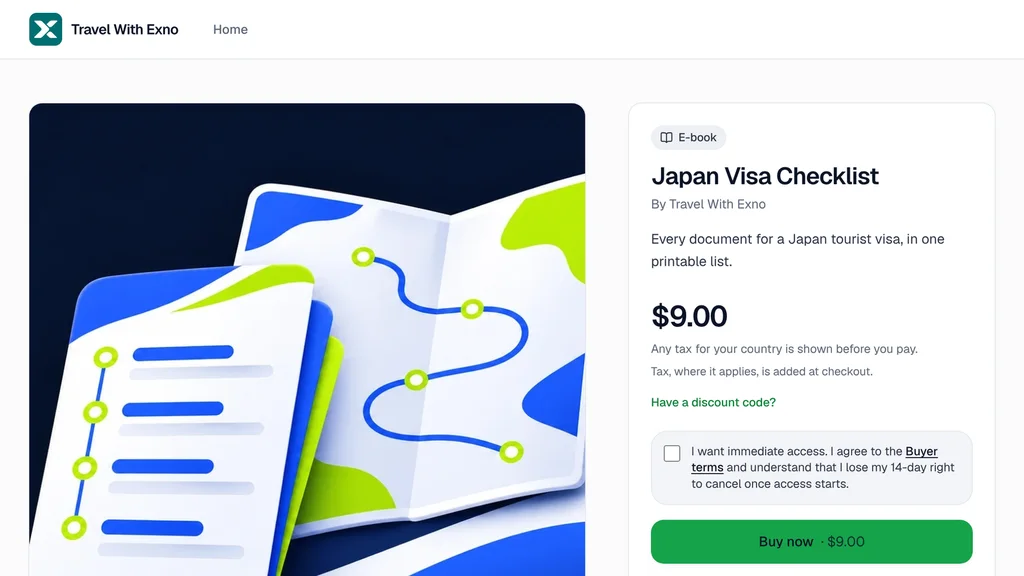
Adding a product takes a few minutes: you create it, write the page buyers see, set a price, add a cover and the files buyers get, and publish. The clips below show every step in a real EXNO store, Travel With Exno, as it adds a Japan visa checklist.
Read the guide
Guide
Where should you sell your digital products?
The best platform to sell digital products depends on what you deliver, how buyers find it, and who should handle the transaction. Shortlist Etsy for original digital designs, Shopify for a shop that also ships goods, Gumroad for direct creator sales, and EXNO for a mixed digital catalog with a storefront and marketplace.
Read the guide
Guide
What to do when a buyer disputes a digital product sale
Chargebacks on digital products happen when a buyer disputes a card payment through their card issuer rather than simply requesting a refund. On EXNO, submit the evidence for each case through the Disputes page; EXNO adds the order records and handles the response, while the disputed sale’s earnings wait for a decision.
Read the guide