Gumroad



 Polar
 Kelviq
 Stan


EXNO creator resources Nigeria · 2026 edition
Digital product ideas built around Nigerian skills and knowledge
By EXNO · Sources checked
Digital products to sell in Nigeria can include recorded gele lessons, original film-editing exercises, Pidgin voice-acting projects, and agbada simulation files. The twelve proposals below explain a possible customer, the task your material would help them perform, and the files you would create. Each has an illustrative naira price with EXNO's commission shown separately.
Summary
Start with an action you know how to explain: matching two film shots, securing a pleat, directing a voice, or interpreting a broken edge. Build an original example that lets someone practice that action. Choose the customer and the learning outcome before deciding how many videos, pages or files the product should contain.
Nigeria: proposed products and the work they help a buyer do
- Local starting points
- Film training, Yoruba head ties, agbada, Benin casting, Pidgin performance and garri processing.[1][2][3][4][5][6]
- Possible customers
- Film and performance tutors, headwrap learners, character artists, museum educators, science teachers and numeracy instructors.
- Useful digital formats
- Original footage, directed recordings, demonstration videos, editable 3D scenes, illustrated activities and worked spreadsheets.
- Two complete editions
- This English article has a full Nigerian Pidgin translation. Both contain the same ideas, details, examples, prices and sources. The selected translation does not represent every language used in Nigeria.
- Preparation references
- The buyer's rehearsal, class or workshop comes first. Annual language and museum observances can provide an optional planning reference.
- Illustrative naira range
- Example selling prices: ₦2,500.00–₦9,000.00.EXNO commission (7%): ₦175.00–₦630.00.
After EXNO commission: ₦2,325.00–₦8,370.00 per sale.
The examples describe one sale in NGN and deduct only EXNO's 7% commission. Other applicable charges, taxes, production expenses and support costs are excluded. The remaining amount is not net profit, an assured payout or a forecast of earnings.
Which digital products could you develop from these Nigerian contexts?
Look for a moment when a learner or practitioner has to make a decision. They may need to choose a usable take, recover a fallen pleat or explain why a model has a hole. Each proposal below turns a specific Nigerian reference into an original exercise, demonstration or tool for that decision.
01Nollywood scene-continuity editing exercises
Film a short original Nigerian scene several times, deliberately changing a cup position, the hand holding a phone, or an actor’s direction of gaze. The Nigerian Film Corporation identifies editing among the skills taught at the National Film Institute in Jos.[1] Use this local training context to build a practical exercise in continuity: making separate shots feel like one uninterrupted action.
Give learners the raw takes, a simple script, and two possible edits with explanations. They should choose which shots join convincingly and explain their compromises. Specify the spoken language and provide an English transcript. A preview can show one troublesome cut and the relevant frames; the paid files supply the full scene and reasoning.
- Who buys: Film-editing tutors and emerging editors practicing continuity with an original Nigerian scene.
- Use when: Before an editing workshop or a learner’s first dialogue-scene assignment.
- Format: Original raw takes, script, transcript, editable timeline, comparison edits, and explained choices.
- Example price: ₦6,500.00
- EXNO commission (7%): ₦455.00
- After EXNO commission: ₦6,045.00
02Gele pleating and tying video lessons
Record your own gele technique from the learner’s viewpoint, showing where each hand holds, folds, and tucks the cloth. Cooper Hewitt’s discussion of Yoruba head ties describes pleating and arrangement as personal creative expression.[2] Choose a small number of original styles and name the fabric used, because a demonstration should show the material the learner will actually handle.
Break each lesson into preparation, pleat formation, securing, and finishing. Include a slow replay of difficult hand movements, still photographs, and a recovery step for a collapsed pleat. The video-selling guide can help define the lesson files and previews. A finished headwrap photograph should accompany the sequence that produces it.
- Who buys: Gele learners, styling tutors, and experienced stylists teaching their own techniques.
- Use when: Before a styling workshop or while practicing a chosen look for an occasion.
- Format: Original lesson videos, slow replays, hand-position photographs, material notes, and troubleshooting steps.
- Example price: ₦5,000.00
- EXNO commission (7%): ₦350.00
- After EXNO commission: ₦4,650.00
03Agbada cloth-motion practice scenes
Build an original digital agbada and show how its broad sleeves move when a character raises an arm or turns. The Metropolitan Museum describes a Nigerian example as loose-fitting, wide-sleeved, and worn over other clothing.[3] Those features give character artists a specific problem: keeping the robe’s shape while stopping its digital surface from passing through the body or underlying garments.
Supply a plain garment model, a few controlled movements, and before-and-after settings for the cloth simulation. Explain each visible change in ordinary language. Include the software version and clearly label the project as your own garment interpretation. The 3D-model guide helps frame editable files and technical requirements.
- Who buys: Character artists and digital-fashion tutors practicing the movement of a loose agbada over other clothing.
- Use when: When preparing a garment-motion lesson or testing a character’s clothing before animation.
- Format: Original garment and character scene, controlled movements, comparison renders, and explained simulation settings.
- Example price: ₦9,000.00
- EXNO commission (7%): ₦630.00
- After EXNO commission: ₦8,370.00
04Benin lost-wax casting transformation lessons
Help museum educators explain what disappears and what remains during lost-wax casting. In its research on a Benin work, the Metropolitan Museum describes wax enclosed in clay, wax melting out, metal entering the resulting space, and the mold being removed.[4] Create an original simple form and follow those changes with colored layers and short animations.
Ask learners to identify whether each stage contains wax, empty space, clay, or metal, then reveal an explained answer. Label the work as a digital explanation of the process, with Benin’s casting context stated clearly. Avoid reproducing a royal sculpture. The lesson-plan guide can help organize the demonstration, activity sheets, and facilitator notes.
- Who buys: Museum educators and art-history tutors explaining material changes in Benin lost-wax casting.
- Use when: Before a museum-learning session or a lesson about how a cast object is made.
- Format: Original process animations, stage diagrams, sorting activities, answer explanations, and facilitator notes.
- Example price: ₦4,500.00
- EXNO commission (7%): ₦315.00
- After EXNO commission: ₦4,185.00
05Nigerian Pidgin voice-acting practice scenes
Write short original Nigerian Pidgin scenes in which the same line carries different intentions: reassurance, impatience, suspicion, or relief. BBC Media Action’s account of Nigerian radio drama discusses the importance of language, dialect, and tone to believable characters.[5] Turn that performance problem into acting practice, with clear relationships and a concrete reason for each speaker to respond.
Record contrasting readings with consenting performers and explain how pauses, pace, and emphasis change the scene. Identify the speakers’ chosen variety without presenting one accent as universal. Include scripts, direction notes, and space for learners to compare their own recordings. The online-course guide helps set out the sequence and what each lesson teaches.
- Who buys: Voice actors, drama tutors, and audio storytellers practicing character intentions in Nigerian Pidgin.
- Use when: Before a voice-acting workshop or rehearsals for an original audio scene.
- Format: Original scripts, contrasting recorded performances, direction notes, transcripts, and self-review prompts.
- Example price: ₦5,500.00
- EXNO commission (7%): ₦385.00
- After EXNO commission: ₦5,115.00
06Garri processing-stage sorting activities
Create a classroom activity that follows cassava through the changing forms involved in making garri, also written gari. IITA’s report describes Nigerian gari-processing technology and the sequence from roots to mash, pressed cake, and granules.[6] The useful task is identifying each material state and explaining the operation that connects it to the next.
Use your own illustrations or authorized photographs of roots, mash, pressed cake, and granules. Give learners shuffled stage cards, arrows, and a completed sequence with commentary. Add a comparison question about what pressing changes versus what size reduction changes. Keep the product focused on process vocabulary and sequence; it is a teaching activity rather than a production recipe or food-safety manual.
- Who buys: Agricultural educators and vocational tutors introducing the stages and material forms of garri processing.
- Use when: Before an introductory processing lesson or a supervised visit to a teaching facility.
- Format: Original material-state illustrations, printable stage cards, editable flow diagram, and explained sequence.
- Example price: ₦3,000.00
- EXNO commission (7%): ₦210.00
- After EXNO commission: ₦2,790.00
07Oríkì performance-brief workbook
Design a briefing workbook for a performer preparing an original personal praise piece. Oríkì is a Yoruba oral praise genre; a University of Ibadan researcher describes forms connected with names, families, and towns.[7] A useful brief helps the performer establish the client’s preferred name and pronunciation, the intended audience, and which personal qualities the piece should recognize.
Include an interview sheet, a place to attach the client’s pronunciation recording, a permission checklist for supplied family material, and a review page for the proposed wording. Demonstrate the process with an invented client and newly written examples. Make room for topics the client wants omitted. The product supports a thoughtful commission without supplying supposedly authentic praise for an unknown lineage.
- Who buys: Oríkì performers and creative-writing tutors preparing original, personally commissioned praise performances.
- Use when: After agreeing the purpose of a commission and before writing or recording it.
- Format: Editable interview and briefing pages, pronunciation-reference fields, fictional example, and wording-review checklist.
- Example price: ₦3,500.00
- EXNO commission (7%): ₦245.00
- After EXNO commission: ₦3,255.00
08Dùndún speech-and-drum pitch comparisons
Pair newly written Yoruba utterances with newly recorded dùndún responses, then show their pitch contours: lines indicating how high or low a sound moves over time. Research with performers recorded in Nigeria documents correspondences between speech and talking-drum pitch and timing.[8] This gives music and language educators a concrete listening task: following a phrase through two forms of expression.
Work with a knowledgeable speaker and drummer, secure permission for the recordings, and have them review the explanations. Provide synchronized playback, readable contour diagrams, transcripts, and prompts about matching rises, falls, and pauses. Use only the project’s original phrases. Keep comparisons centered on speech correspondence, with credits and enough context to explain the performer’s interpretation.
- Who buys: Music and language educators teaching how Yoruba speech patterns can be represented on the dùndún.
- Use when: When preparing a lesson connecting spoken language, listening, and changing musical pitch.
- Format: Authorized original paired recordings, synchronized comparison player, pitch diagrams, transcripts, and teaching commentary.
- Example price: ₦7,500.00
- EXNO commission (7%): ₦525.00
- After EXNO commission: ₦6,975.00
09Nok-context digital fragment-refitting puzzles
Build a fictional hollow clay figure digitally, show the coils used to form its wall, and divide it into fragments for a reconstruction exercise. The Metropolitan Museum describes Nok sculpture from Nigeria as commonly hollow and coil-built, with many surviving bodies fragmented.[9] That construction matters: learners must consider wall thickness and curvature as well as the visible broken edges.
Supply movable fragments, close-up edge views, and several possible joins. Let learners mark a join as supported, doubtful, or unresolved, preserving gaps where the supplied pieces provide no answer. Include an explained solution for your invented object. Identify every file as a new teaching model, with no claim to reconstruct a particular excavated sculpture or its missing features.
- Who buys: Archaeology educators and museum-learning facilitators teaching cautious reconstruction from fragmentary material.
- Use when: Before a lesson on archaeological evidence, object reconstruction, or Nok terracotta construction.
- Format: Original hollow teaching model, movable digital fragments, edge views, uncertainty markers, and explained joins.
- Example price: ₦6,000.00
- EXNO commission (7%): ₦420.00
- After EXNO commission: ₦5,580.00
10Appliance-use timeline workbook for energy lessons
Make a workbook that helps learners distinguish an appliance’s power rating from the energy used over time. Nigeria’s Rural Electrification Agency documents renewable-energy training at the University of Maiduguri.[10] Use that educational context for fictional household or small-workshop scenarios in which learners place lights, fans, and other stated loads on a daily timeline.
Let users change the hours of use and see how the energy total and overlapping demand change. Explain every unit, give a worked example, and label all figures as teaching assumptions. The spreadsheet-template guide helps describe editable inputs and protected calculations. Keep the scope to arithmetic and timing; equipment selection and installation design need separate professional work.
- Who buys: Energy-literacy educators and vocational tutors teaching appliance power, running time, and overlapping use.
- Use when: Before an introductory energy lesson or a workshop comparing fictional daily-use scenarios.
- Format: Editable timeline workbook, stated assumptions, unit explanations, worked scenarios, and formula notes.
- Example price: ₦4,000.00
- EXNO commission (7%): ₦280.00
- After EXNO commission: ₦3,720.00
11Photogrammetry camera-coverage practice sets
Photograph your own textured bowl from several heights and directions, then produce complete and deliberately incomplete image sets. Photogrammetry builds a digital shape from overlapping photographs. Factum Foundation documents teaching this method to Igbo-Ukwu community members at the National Museum in Lagos in May 2024.[11] The teaching opportunity is understanding how missing viewpoints leave parts of a reconstruction uncertain.
Provide the original photographs, camera-position diagrams, and resulting models so learners can connect a gap to the views that were omitted. Add a second set that resolves the gap. State the software version and processing settings. Keep the subject an object you made or are authorized to photograph, with no museum scans or collection photographs included.
- Who buys: Digital-heritage tutors and beginning 3D-capture practitioners studying photographic coverage.
- Use when: Before a photogrammetry class or a learner’s first authorized object-recording project.
- Format: Original photograph sets, camera-position diagrams, comparison models, processing notes, and missing-view exercises.
- Example price: ₦8,000.00
- EXNO commission (7%): ₦560.00
- After EXNO commission: ₦7,440.00
12Naira change-making practice game
Build a numeracy game in which learners calculate change and choose a combination of available naira values. The Central Bank of Nigeria’s currency-structure document lists banknotes from ₦5 through ₦1,000.[12] Use plain value buttons or clearly fictional classroom tokens, so the activity teaches arithmetic without reproducing real banknote designs.
Let a tutor set invented prices, amounts tendered, and which values are available. Include questions with several valid answers and cases where the chosen set cannot make exact change. Explain why each solution works, with an option to count upward from the price. Supply a browser version and printable practice sheets using the same scenarios. State that the prices are invented teaching examples.
- Who buys: Numeracy tutors and vocational educators teaching change calculations with Nigerian currency values.
- Use when: When learners can add and subtract amounts and are ready to compare alternative change combinations.
- Format: Original browser game, editable scenario list, abstract value tokens, printable exercises, and explained answers.
- Example price: ₦2,500.00
- EXNO commission (7%): ₦175.00
- After EXNO commission: ₦2,325.00
Which part of your knowledge makes the download useful?
A local reference is only a starting point. Buyers need the knowledge that lets them notice, choose or correct something: the order of a gele fold, the intention in a spoken line, or what a broken edge can reveal. Put that judgment into examples and explanations the buyer can work through.
| Proposed product | Decision to explain | Evidence inside your files |
|---|---|---|
| Gele lesson | Which edge is being held, folded or tucked at this point? | A consistent camera view, a clearly identified cloth corner and a replay of the hand movement. |
| Pidgin voice exercise | What does the character want from the listener? | Your original scene, contrasting readings and a direction note connecting the performance to its context. |
| Nok-context refitting puzzle | Does the available edge support this join? | Close views of wall thickness and curvature, including an explicit unresolved option for missing evidence. |
| Oríkì briefing workbook | Which personal details may the performer use? | An invented worked brief that distinguishes confirmed pronunciation, permitted material and topics to omit. |
Make the reasoning as reusable as the file.
A source can tell you where a practice belongs and describe a documented technique. Your contribution is the demonstration, explanation or exercise you make yourself. Identify it as your own work, credit collaborators accurately, and separate documented facts from the choices you made for teaching.
What should accompany the files for a buyer outside Nigeria?
A buyer elsewhere needs enough context to use the material without guessing what a term, gesture or file represents. Explain the task, the assumed skill level and the language of any recording. For the same lesson in another language, preserve its examples and qualifications while letting the explanation follow that language's natural phrasing.
| Part of the offer | What to specify | Example from this article |
|---|---|---|
| Spoken content | The language or variety actually recorded, the performer's role and any accompanying transcript. | A Pidgin acting scene keeps its character relationships and intentions when its teaching notes are translated. |
| Physical demonstration | The materials, viewpoint and steps visible in the supplied recording. | A gele learner can identify the cloth and follow the same corner through the complete sequence. |
| Editable project | The application, tested version, required files and intended learning task. | An agbada scene explains the movement and the cloth settings that the buyer will inspect. |
| Cultural context | The documented reference, your authorship and the limits of the interpretation. | A newly designed lost-wax lesson explains material changes without offering a replica of a museum object. |
A diaspora workshop organizer and an overseas design tutor may use the same subject for different purposes. Ask what their participants need to do, then describe the edition that serves that task. Avoid assuming a shared language, prior cultural knowledge or technical experience from the buyer's location.
The Nigerian Pidgin edition accompanying this article translates the full English original. Its phrasing changes naturally; the product ideas, source meanings, price calculations and limitations remain aligned.
Choose a rehearsal date and work back from it
A useful deadline starts with the day someone will rehearse a scene, teach a process or test a garment. Agree on that task before setting delivery. The calendar below combines two annual observances with practical review windows, leaving time to correct the actual files before a buyer uses them.
| Preparation window | Basis for planning | Files to finish and check |
|---|---|---|
| Late November–December 2026 | A starting window for a buyer who wants to try your original continuity-editing exercise. | Lock the practice scene, label its takes and test the intended edit. Let the buyer inspect one continuity problem and its explanation before agreeing on the full lesson's delivery date. This is a proposed work schedule, not a film-release calendar. |
| January–early February 2027 | International Mother Language Day falls on February 21.[13] A language-related session needs its own booking. | If a trainer plans a Pidgin voice-acting session around the observance, settle the original script and intended performance before recording examples. Check the spoken meaning and direction notes together. The reference does not make Pidgin every participant's first language. |
| April 2027 | International Museum Day is observed each year on May 18.[14] Confirm any museum's 2027 program independently. | For an agreed learning session, review the lost-wax process model with the educator. Make each stage distinguishable, identify simplifications and confirm which views learners need. Finish the checked teaching files before the educator's rehearsal. |
| Before a gele workshop | The instructor's chosen fold sequence and the learner's stated starting level. | Try the illustrated sequence on the specified cloth and photograph any step that becomes hidden under the next fold. Check that the written direction matches the demonstrator's hands, then allow the instructor time to review the complete sequence. |
| Before a garment-simulation lesson | The buyer's software, model and agreed movement test. | Open the agbada scene in the stated software version and run the supplied movement. Compare the garment's resting shape with its moving result, record the settings and explain where the model departs from a physical garment. |
| Before a processing-workflow class | The trainer's chosen garri-processing example and lesson objective. | Match the original pictures to roots, mash, pressed cake and granules. Test whether the shuffled cards and arrows lead to the explained sequence, and distinguish pressing from size reduction. Have the trainer review the learning activity before delivery; it is not a production recipe or food-safety manual. |
Preparation windows and review tasks are editorial suggestions. February 21 and May 18 are annual reference dates; they do not confirm a local 2027 event. Agree separately on each buyer's program, review time and delivery date. These entries make no claim about seasonal demand or likely sales.
How can you set a naira example without promising earnings?
Describe the edition before assigning its price. A change-making game might contain a small set of worked scenarios; an acting project might include recordings and direction notes; a garment scene might include several tested movements. The example amounts illustrate those different scopes and a commission calculation, without claiming to be observed market prices.
The digital-product pricing guide can help you compare the work included in each offer. If you prepare editions for different audiences, consult the purchasing-power pricing guide and describe each edition clearly. These examples use NGN throughout and make no currency conversion.
| Example edition | Example price | EXNO commission (7%) | After this commission |
|---|---|---|---|
| Naira change-making practice game | ₦2,500.00 | ₦175.00 | ₦2,325.00 |
| Nigerian Pidgin voice-acting practice scenes | ₦5,500.00 | ₦385.00 | ₦5,115.00 |
| Agbada cloth-motion practice scenes | ₦9,000.00 | ₦630.00 | ₦8,370.00 |
Commission = example price × 0.07. Remaining amount = example price − commission. This calculation excludes other applicable charges, taxes and your own costs.
EXNO's current pricing page specifies 7% commission on both direct and Discover sales. That rate is the deduction shown in every product example here.
For a small introductory exercise, pay-what-you-want pricing can let the buyer choose an amount under the terms you set. A discount code can identify an offer for a defined class or rehearsal group. State which edition the offer covers and whether feedback or personal instruction is included.
What can a preview show before someone commits to the full lesson?
A useful preview lets a prospective buyer judge the part of the product they care about. Show the teaching voice, an editable decision or a small piece of the exercise at its actual level. Use material from the edition being sold so the preview and the purchased files make the same promise.
- Let the film viewer inspect a cut. Put two of your original takes beside the edited result. Explain the cup position or eyeline that influenced your choice.
- Show the difficult moment in the gele sequence. Include the hand movement and its immediate result, so viewers can judge whether the camera angle and explanation suit them.
- Give the acting scene a clear intention. Play two authorized readings of the same original line and describe what the speaker wants in each version.
- Reveal what the missing photographs change. For the photogrammetry lesson, show the incomplete view coverage beside the resulting gap and the additional view that helps resolve it.
A film-training group, craft instructor or museum-learning contact may be an appropriate audience for the corresponding sample. Ask the organizer before sharing a commercial demonstration in their space. On your own page, accompany video or audio with a written account of the task, the included files and the edition's requirements. These are editorial promotion suggestions, not claims about channel popularity or conversion.
How do you turn one of these ideas into a first usable edition?
Choose a modest deliverable with a beginning, a decision and an explained result. Follow that whole sequence using the files you intend to supply. This exposes missing material early: a camera angle, a pronunciation note, an unlabeled input or a step that only makes sense because you already know the answer.
- Write the buyer's task. Specify the result: selecting a matching film take, following a headwrap sequence or defending a proposed fragment join.
- Make the original teaching material. Record the footage, construct the scene or draw the activity. Secure the necessary permissions from collaborators and identify who did what.
- Run the full exercise. Start from the buyer's supplied files and compare the outcome with your explanation. Keep unresolved cases where the exercise is designed to teach uncertainty.
- Check the instructions with an appropriate reader. Ask someone with the intended skill level to follow the sequence. Correct the point where your explanation assumes information the files never provide.
- Prepare the description and preview together. Name the file types, requirements, permitted use and included assistance. Keep translated explanations matched to the same edition.
On EXNO, bring that description, preview and finished download into one product listing. Use a payment link to point an interested reader to the defined offer after they have seen the relevant sample.
Which mistakes would weaken these particular downloads?
Review the relationship between the promised task and the evidence the buyer receives. A polished final image cannot explain an unseen hand movement, and a completed model cannot show which camera view was missing. Check the details below in the actual files, then make the description reflect what the edition can demonstrate.
- Changing the viewpoint without warning. A mirrored gele shot can reverse the learner's left and right. State the view convention and explain any switch.
- Explaining a voice through an accent stereotype. Give the character an intention and context. Describe the particular performance rather than treating one delivery as the voice of every Nigerian.
- Filling every missing fragment. A refitting exercise should allow uncertainty. Show which edges support a join and where the fictional model intentionally leaves the learner without enough evidence.
- Treating cultural context as permission. A source about a museum object or praise tradition does not supply rights to copy the institution's photographs, a performer's recording or a family's material.
- Confusing a classroom model with operational advice. Garri stage cards explain material states; the energy workbook explains stated arithmetic. Describe those teaching limits accurately.
- Supplying an unexplained finished reconstruction. A photogrammetry exercise needs the photographs, omitted viewpoints and processing context that let learners understand the gap.
Two neighboring contributions, two independent creators
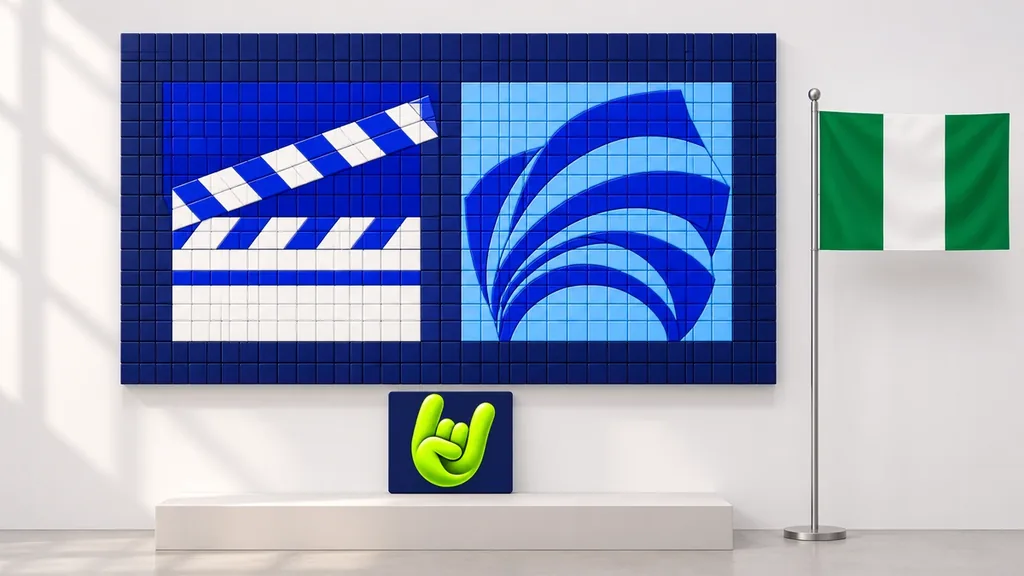
A film editor and a gele teacher could design complementary motifs for separate areas of the EXNO Pixel Wall, if neighboring spaces are available. Each chooses their own area; the idea needs no shared shop or joint purchase. Consider it an optional creative contribution. The wall has a 1,000 × 1,000 grid at $1 per pixel, with an image or color, a title and an optional link. EXNO reviews submissions and fully refunds declined ones. Contributions help develop the platform. The illustration is conceptual; placement promises no visits, sales or search advantage.
Questions about making these Nigerian digital products
These answers address decisions that change the product itself: what the recordings teach, how a model handles uncertainty, and what a customer can infer from an example. Use them to keep the promised outcome close to the files you can actually prepare.
What makes a film-continuity exercise useful to an editor?
The learner needs enough original takes to make a real choice, along with the relevant script and an explanation of the resulting edit. A deliberate change in hand position or gaze gives the exercise a clear problem. Include the reasoning behind more than one workable answer where appropriate.
Does a gele tutorial need to cover many styles?
It can begin with a small, clearly described selection that the recording explains completely. Show the fabric, hand movements, securing steps and finished result. A well-explained recovery from a collapsed pleat can be more useful than adding another style with missing steps.
Should every Nigerian Pidgin acting scene use the same accent?
Identify the variety and performers used in your project. Direct the character's intention, relationship and situation, and explain the choices in the particular recording. Do not present one accent or style as appropriate for every Nigerian speaker or audience.
Can a digital Nok puzzle establish how a real sculpture looked?
The proposed puzzle uses an object you invent for teaching. Its answer explains how those supplied fragments fit and which gaps remain unresolved. That exercise does not establish the missing features of an excavated object or replace archaeological evidence.
Can an appliance-use workbook tell a buyer which solar system to install?
The proposed workbook compares stated appliance ratings, hours of use and overlapping loads. Its numbers are fictional teaching assumptions. Selecting equipment, assessing a site and designing a safe installation require separate professional work.
Why offer a change-making question with no exact answer?
Restricting the available values lets a learner explain why an exact amount cannot be formed. Other questions can allow several correct combinations. Mark the scenario clearly and provide reasoning, so an intentional constraint is distinguishable from an error in the exercise.
Sources behind the Nigerian contexts and preparation references
These sources support the specific cultural, educational, technical and annual-observance facts cited in the article. The twelve product proposals, possible buyers, preparation suggestions and naira prices are EXNO editorial examples. A citation does not show that an offer has been tested commercially or endorsed by the source. Sources checked .
- Nigerian Film Corporation — Departments — National Film Institute. NFI’s editing and filmmaking training in Jos; context for an independently created continuity exercise.
- Cooper Hewitt, Smithsonian Design Museum — Yoruba Complete. Gele folding, pleating, tucking and personal arrangement, discussed by a textile curator in 2015.
- The Metropolitan Museum of Art — Agbádá (man’s ceremonial robe), object 2014.751.1. The Nigerian robe’s broad sleeves, loose shape and placement over other clothing; the proposed digital garment is original.
- The Metropolitan Museum of Art — Recovering the Brilliance of a Benin Bronze. The sequence from wax and clay to an empty mold and cast metal, explained through research on a Benin work.
- BBC Media Action — Governance — Radio drama in Nigeria: Story Story. The producer’s historical account of Nigerian Pidgin radio drama, character language, dialect and tone; no program script is reused.
- International Institute of Tropical Agriculture (IITA) — Potential for commercial production and marketing of cassava: Experiences from the small-scale cassava processing project in East and Southern Africa. The 2013 report, pages 19–21, describes Nigerian gari-processing technology used in Mozambique and the changing forms of cassava.
- Ifeoluwa Theophilus Akinsola, Journal of Aesthetics & Culture — Oríkì and trending hype performance in Nigeria: an aesthetics of cultural hybridisation for economic purpose. The 2025 published research paper was read through its Academia.edu mirror. It describes Yoruba praise poetry and forms associated with names, families and towns.
- Cecilia Durojaye and coauthors, Frontiers in Communication — When Music Speaks: An Acoustic Study of the Speech Surrogacy of the Nigerian Dùndún Talking Drum. A 2021 study of speech and dùndún pitch and timing, with performances recorded in Nigeria; proposed recordings would be new.
- The Metropolitan Museum of Art, Department of Arts of Africa, Oceania, and the Americas — Nok Terracottas (500 B.C.–200 A.D.). The 2000 museum essay supports the hollow, coil-built construction and fragmentary survival used in the fictional refitting exercise.
- Rural Electrification Agency, Nigeria Electrification Programme — REA Kicks Off Renewable Energy Training Programme, 100 Young Nigerians Enrolled. A historical report of renewable-energy training launched at the University of Maiduguri in September 2025; educational context only.
- Factum Foundation — The Igbo-Ukwu Bronzes. The project team’s account of photogrammetry training with Igbo-Ukwu community members in Lagos in May 2024.
- Central Bank of Nigeria, Currency Operations Department — Clean Note Policy — Nigerian Currency Structure. The September 2018 document’s banknote-value list supports arithmetic examples; no claim about note-design validity or exchange procedures is made.
- UNESCO — International Mother Language Day. The annual February 21 observance; the page’s 2026 activities are not a 2027 event announcement.
- International Council of Museums — Museums Uniting a Divided World. The annual May 18 observance; the source’s 2026 theme does not establish a 2027 theme or a Nigerian museum event.
The linked EXNO guides, pricing information, country guides and Pixel Wall page were also checked. The commission and remaining amounts are calculations using the stated 7% rate.
Image sources and creation
The three editorial illustrations were created on November 25, 2026 with ChatGPT's built-in image generation and the EXNO references supplied by the brand. Each contains one EXNO logo variant and the Nigerian flag. Each was converted to WebP immediately after generation and embedded in both complete language editions.
- Hero: An imagined creative workspace with film materials and a blue gele; one EXNO wordmark.
- Sharing image: Conceptual garment and casting-study objects; one EXNO hand emblem.
- Pixel Wall: Separate neighboring film and gele motifs; one EXNO hand emblem.
No photograph or scan from the cited sources is reproduced. These images are not evidence of a tested product, an archaeological reconstruction, a completed financial transaction or an actual collaborative placement.
Product ideas and example prices are illustrations, not earnings estimates.


Choose a task you can demonstrate from beginning to end
Create its original files, explain the decisions and let the preview show the kind of work the buyer will receive.