Gumroad



 Polar
 Kelviq
 Stan


EXNO · Ideas for digital sellers United Arab Emirates · 2026
Digital products to create and sell in the United Arab Emirates
EXNO editorial guide · Checked · English and Arabic
Digital products to sell in the United Arab Emirates can draw on Emirati craft knowledge, local scientific work, Arabic–English communication, and the everyday needs of small businesses. Consider an original Talli documentary, a wind-tower 3D model, a Mars-observation lesson, or a bilingual catalog tool: each gives a specific buyer something useful to work with.[1][2][6][12]
Summary
Choose a product whose usefulness you can demonstrate: a model that opens correctly, a transcript that preserves who spoke, or a workbook that reveals a missing item in a quote. The first eight ideas rely on specific UAE knowledge; the final four adapt broader digital formats to local buyers. These are proposals to test, not a ranking of sales.
United Arab Emirates: digital product ideas at a glance
- Local foundations
- Wind-tower architecture, Talli, pearling history, Mleiha archaeology, the Hope mission, marine surveys, Emirati speech, and Al-Ayyala.
- Possible buyers
- Educators, museum teams, filmmakers, performing groups, developers, exhibitors, independent shops, and holiday-home hosts.
- Useful formats
- Editable 3D assets, captioned films, audio drama, documented code, interactive lessons, spreadsheets, printable artwork, and custom digital design.
- Language decision
- Use Arabic, English, or both according to the actual buyer. Name the spoken variety when an audio product uses Emirati Arabic; offer readable captions.
- Preparation windows
- Late-2026 heritage activities, the published school breaks, and the announced April 2027 literature festival; dates and scope appear below.
- Example arithmetic
- AED 55.00 price → AED 3.85 EXNO commission at 7% → AED 51.15 after that commission only. Other applicable charges and taxes are excluded.
Which UAE product ideas solve a clear buyer problem?
The useful starting point is a buyer’s unfinished task: explaining a wind tower, preparing a recorded interview, or comparing observations. The twelve proposals below turn specific UAE knowledge into files someone can use. Their sources establish the local context; they do not establish how many people will buy.
Every price is an illustrative starting point in AED. The commission and remainder are shown separately using EXNO’s current 7% rate for both direct and Discover sales.[20] The remainder is before other applicable fees, taxes, and production costs; it is neither profit nor a promised bank payout.
01A wind-tower model that shows the air path
Build a sectional model of a barjeel, the wind tower found in traditional Dubai houses. Al Shindagha Museum explains how its shaft draws air into the room below.[1] Let an educator hide the outer walls and reveal that connection. Include an editable model, an explanatory animation, and a note identifying simplified geometry; avoid presenting the animation as measured cooling performance.
- Who buys: Architecture tutors and exhibition animators.
- Why it is useful: A photograph cannot show the hidden shaft.
- Files: GLB, editable 3D source, MP4, and PDF notes.
- Timing and preview: Before a heritage lesson; show the model opening into a section.
- Example price: AED 90.00; commission AED 6.30; after commission AED 83.70.
Define compatible files and usage rights with the guide to selling 3D models and game assets.
02A Talli maker’s short documentary
Commission and film a practitioner explaining a piece of Talli, including the material choices and the story of learning the craft. Abu Dhabi’s culture authority describes its braided strips and intergenerational teaching.[2] The product is your finished, permission-cleared documentary with Arabic and English captions, a transcript, and discussion prompts. Agree credit, payment, and the permitted uses with the maker before filming.
- Who buys: Heritage facilitators, language teachers, and cultural learning groups.
- Why it is useful: Learners hear the maker’s decisions in context.
- Files: MP4, SRT/VTT captions, and transcript PDF.
- Timing and preview: Prepare well before a cultural program; share a cleared excerpt.
- Example price: AED 65.00; commission AED 4.55; after commission AED 60.45.
The video-selling guide covers how to present the finished video and its delivery files.
03An original pearling-crew audio drama
Write a fictional scene in which a pearl diver, rope handler, captain, and singer each explain their role. The historical relationships are documented by Abu Dhabi Culture.[3] Record original performances, separate the role tracks, and add a glossary. A teacher can pause the scene and ask whose action another crew member depends on. Clearly distinguish your invented dialogue from historical testimony.
- Who buys: Museum learning teams and school drama leaders.
- Why it is useful: A complete scene makes teamwork easier to discuss.
- Files: MP3/WAV, original script, and facilitator notes.
- Timing and preview: Heritage or reading sessions; demonstrate one exchange between roles.
- Example price: AED 45.00; commission AED 3.15; after commission AED 41.85.
04Mleiha evidence and reconstruction cards
Create an activity that asks what an archaeological find supports, what remains uncertain, and what a modern reconstruction adds. Mleiha’s tentative-list submission describes varied evidence of settlement and trade; the nearby Jabal Al-Emaileh tomb also illustrates how older objects and a later burial can occur in one place.[4][5] Use your own schematic drawings and reasoned answers. Label different sites and periods rather than merging them.
- Who buys: History teachers and archaeology outreach teams.
- Why it is useful: Students practice judging evidence, not merely memorizing dates.
- Files: Printable PDF cards, slide deck, and answer commentary.
- Timing and preview: Before a history unit; show one claim with competing interpretations.
- Example price: AED 55.00; commission AED 3.85; after commission AED 51.15.
05A Hope mission observation-comparison notebook
The UAE’s Hope mission studies the Martian atmosphere across daily and seasonal changes, using different instruments.[6] Build a documented lesson that makes a learner check an observation’s instrument and time before comparing it with another. Sell your explanations, code, and worked reasoning. The Science Data Center provides free access after account creation; direct learners to obtain the source files themselves.[7]
- Who buys: University astronomy clubs and science instructors.
- Why it is useful: Similar-looking observations may answer different questions.
- Files: IPYNB notebook, synthetic practice CSV, and PDF instructions.
- Timing and preview: A science teaching block; demonstrate one misleading comparison and its correction.
- Example price: AED 110.00; commission AED 7.70; after commission AED 102.30.
Use the code and plugins guide to describe setup, dependencies, and supported versions.
06A “missing dugongs” classroom experiment
Environment Agency – Abu Dhabi uses aerial surveys to monitor marine animals.[8] Survey guidance explains that glare, water conditions, and observers can affect whether an animal is seen.[9] Turn that distinction into an original interactive exercise: learners change visibility in a fictional scene, compare sightings, and explain why “not seen” does not mean “absent.” Keep all counts synthetic and label the exercise as a teaching model.
- Who buys: Ecology educators and introductory data-science teachers.
- Why it is useful: It makes observation bias visible without a field survey.
- Files: Offline HTML, fictional datasets, and an explanation sheet.
- Timing and preview: Ecology or statistics lessons; show two views of the same fictional population.
- Example price: AED 75.00; commission AED 5.25; after commission AED 69.75.
07Emirati conversation transcripts with speaker turns
Ramsa Lab documents the variety of spoken Emirati Arabic through natural recordings.[10] For your own product, record consenting speakers and create a transcription exercise that preserves pauses, interruptions, and overlapping voices. Give learners the original audio, a blank timing file, an annotated solution, and an English meaning guide. Explain your transcription choices; do not borrow the project’s recordings or present one speaker as representing every Emirati dialect.
- Who buys: Documentary students, transcription learners, and oral-history groups.
- Why it is useful: They can distinguish what was said from who said it when.
- Files: WAV, timecoded CSV/VTT, and bilingual notes.
- Timing and preview: Research-skills teaching; demonstrate one overlapping exchange.
- Example price: AED 80.00; commission AED 5.60; after commission AED 74.40.
08An Al-Ayyala rehearsal viewer with matched camera angles
Al-Ayyala involves facing rows of performers, coordinated movements, poetry, and musicians; local versions differ.[11] Work with a participating group to build a simple viewer that switches between front and side recordings while preserving the same instant. Include a synchronized, permission-cleared example and an instructor’s cue notes. This lets a group inspect a shared entrance or movement without confusing footage recorded at different moments.
- Who buys: Heritage performing groups and their video editors.
- Why it is useful: Matched viewpoints reveal group coordination.
- Files: HTML/JavaScript source, sample MP4s, and synchronization notes.
- Timing and preview: Rehearsal preparation; show an angle change at one shared cue.
- Example price: AED 120.00; commission AED 8.40; after commission AED 111.60.
09An Arabic–English catalog search starter
Build a small catalog that connects Arabic and English product names to the same item ID. The UAE government identifies Arabic as the official language and notes the use of Arabic and English on commercial signs.[12] Give a shop owner an original search tool, fictional sample items, and clear editing instructions. Define supported spellings and aliases explicitly so the preview shows what the search can actually find.
- Who buys: Independent shops, makers, and developers serving bilingual clients.
- Why it is useful: Either language can lead to the same item details.
- Files: HTML/JavaScript, CSV/JSON sample catalog, and setup notes.
- Timing and preview: Before a catalog refresh; search for one item in both languages.
- Example price: AED 60.00; commission AED 4.20; after commission AED 55.80.
10An exhibition-supplier quote comparison workbook
Dubai World Trade Centre’s event-hosting services establish a concrete local exhibition setting.[13] Create a workbook that helps an exhibitor compare supplier quotes when one includes furniture and installation but another lists them separately. Use fictional AED quotes, explicit quantity units, and an included/excluded column. The buyer supplies actual offers; your workbook organizes them without inventing local supplier prices or treating missing items as free.
- Who buys: Small exhibitors and independent event coordinators.
- Why it is useful: Different scopes can make headline totals misleading.
- Files: XLSX, worked fictional quotes, and a short walkthrough.
- Timing and preview: During supplier selection; reveal one scope gap in a sample comparison.
- Example price: AED 100.00; commission AED 7.00; after commission AED 93.00.
11A coordinated UAE neighborhood art-print trio
Draw three original scenes that belong together: Al Ain palms, an imagined Sharjah courtyard, and an Abu Dhabi waterfront evening. Al Ain’s oasis landscape provides a documented place reference.[14] Sell finished artwork with matching color, tested print exports, and crop previews. Label imagined compositions as such; do not trace tourism photographs or claim a fictional courtyard depicts a named monument.
- Who buys: Residents, people who have moved abroad, and interior stylists.
- Why it is useful: A coordinated set is ready to display together.
- Files: Print-ready PDF/JPEG, screen files, and size guide.
- Timing and preview: Home updates or gifting; show the actual artwork at its available crops.
- Example price: AED 40.00; commission AED 2.80; after commission AED 37.20.
12A custom holiday-home guest handbook
Dubai’s tourism department identifies holiday-home providers within its hospitality services.[15] Offer a tightly scoped digital design service for one host-approved property: a mobile Arabic–English PDF with appliance illustrations, amenity information, and clear navigation. Work from the client’s verified instructions and original or authorized images. State page limits, language responsibilities, revisions, and handover files before accepting the job.
- Who buys: Individual holiday-home hosts and small operators.
- Why it is useful: Guests can find the property’s practical information in one place.
- Files: Linked PDF, editable source, and an approval checklist.
- Timing and preview: Before a listing launch or update; use a fictional property in your public sample.
- Example price: AED 180.00; commission AED 12.60; after commission AED 167.40.
Describe the scope using the guide to selling services; this offer is digital design, with printing excluded.
Where does local knowledge improve the actual product?
Local knowledge matters when it changes a decision inside the product. Knowing a place name is insufficient: you need to distinguish a maker’s account from your narration, a documented archaeological context from a guess, and an Emirati speaker’s own usage from a general Arabic translation. Those distinctions make the finished files more useful.
- Keep a reconstruction honest. The cited Mleiha entry is on UNESCO’s Tentative List. That status is different from an inscribed World Heritage property. Your evidence cards should also distinguish a find, its context, and the interpretation you ask students to discuss.[4][5]
- Credit a living practice. A Talli maker’s explanation and an Al-Ayyala group’s approach belong to identifiable people and traditions. Record their preferred terms, agree reuse, and let them check how their contribution is described.[2][11]
- Keep dialect and translation separate. Preserve a speaker’s words in the transcript. Add an English explanation as a separate layer, and identify where a word or turn remains uncertain. Ramsa Lab’s attention to dialect variety is a useful reminder that one recording cannot represent the whole country.[10]
What can a buyer outside the UAE use?
Buyers abroad need enough context to use your work without being in the room with you. A university might need an editable teaching asset; a family might want finished artwork; a filmmaker might need a clearly licensed clip. Prepare the explanation and permissions around that use, rather than adding a country label.
| Buyer | Useful offer | What to make explicit |
|---|---|---|
| Architecture educator overseas | Barjeel model and sectional animation | Editable parts, simplified geometry, software requirements, and teaching-use permission. |
| Community or heritage group abroad | Talli documentary or original pearling drama | Arabic/English captions, context notes, and the agreed screening or performance rights. |
| Person with a connection to the UAE | Finished neighborhood art trio | Exact crops, print sizes, color guidance, and whether use is personal or commercial. |
| Small studio serving UAE clients | Catalog search starter | Editable language fields, supported search behavior, and the limits of included support. |
Show the buyer the decision your file makes easier.
Which dates should shape preparation in late 2026 and 2027?
Use the calendar to work backward from a possible use date. A finished heritage clip can be ready for early December; commissioning a new documentary needs more time. The dates below are published occasions or school milestones, with suggested preparation uses. They are not evidence of a sales peak or confirmed orders.
| Date | Occasion and scope | Possible buyer need | Product preparation |
|---|---|---|---|
| December 2, 2026 | Eid Al Etihad national occasion.[18] | Heritage-session material that is already ready to use. | Offer a finished pearling scene or cleared documentary excerpt; avoid promising a rushed commission. |
| December 14, 2026 | Winter break begins in the MOE calendar.[16] | Self-contained activities for a planned break program. | Test the archaeological cards and all answer notes before the break. |
| January 4, 2027 | Classes resume after winter break under the published MOE timetable.[17] | Teaching materials a tutor can prepare before classes restart. | Make the Hope notebook’s setup instructions and sample run available in advance. |
| April 5, 2027 | Spring break begins in the MOE calendar.[16] | Short workshop activities with a clear stopping point. | Package a complete wind-tower explanation or dugong observation exercise. |
| April 14–20, 2027 | Emirates Literature Festival; dates announced by the organizer.[19] | Original listening and reading activities for independently organized sessions. | Prepare the audio drama or transcript exercise; do not imply a festival partnership. |
| July 2, 2027 | End of the student academic year in the MOE calendar.[16] | Reusable material for a planned summer learning program. | Provide standalone instructions so the activity can work beyond a regular classroom. |
The school dates cited here apply to public schools and private schools following the Ministry of Education curriculum. Confirm the buyer’s own school calendar. December 2 identifies the national occasion; the separate federal-government leave announcement covers December 2–4, 2026 and should not be treated as every organization’s event schedule.[16][18]
How can you price a small file and a larger use?
Price the scope a buyer receives: the working file, its instructions, its permitted use, and any personal adaptation. A local independent tutor may need one ready-to-use example; an institution abroad may need editable teaching materials and wider permission. Geography alone does not explain the price. Start by defining those differences in writing.
Use digital-product pricing to establish a sensible starting scope. For international audiences, the purchasing-power pricing guide can help you consider affordability without assuming all UAE buyers share one budget. These examples keep everything in AED and make no exchange-rate comparison.
| Clearly defined offer | Example price | EXNO 7% | After commission only |
|---|---|---|---|
| Individual model, animation, and basic instructions | AED 90.00 | AED 6.30 | AED 83.70 |
| Instructor edition with editable lesson files and stated classroom rights | AED 180.00 | AED 12.60 | AED 167.40 |
| One agreed digital adaptation, with a stated revision limit | AED 300.00 | AED 21.00 | AED 279.00 |
The last column subtracts EXNO’s 7% sales commission only. Other applicable charges, taxes, and your own costs remain outside these calculations.[20]
EXNO supports pay-what-you-want pricing and discount codes. A flexible price can suit a small introductory file; a discount can apply to a clearly defined offer for a limited period. Show the actual discounted amount, and keep the scope and usage rights visible.
How can a UAE buyer assess your work before paying?
Show the product doing its job in the language the buyer will use. A short video, a working sample, or a completed comparison usually explains more than a list of file extensions. Choose a place where your intended audience already interacts, then ask for specific feedback on the demonstration instead of assuming demand.
- For teachers and cultural groups: Share a short sample in a relevant professional group that permits promotion. Let an educator see the answer reasoning, captions, or instructor notes. A polished cover alone cannot show whether a lesson works.
- For shops and exhibitors: Demonstrate the bilingual search or the quote comparison in a screen recording. Put the sample in a product post or a permitted WhatsApp conversation with a potential client. Use fictional names and quotes.
- For artwork and video buyers: Use Instagram or a video channel to show actual crops, playback quality, and a sample of captions. Distinguish the purchased file from a decorative mockup, and keep other people’s work out of the preview.
What should you finish before your first EXNO listing?
Finish one deliverable and make its boundaries easy to understand. A buyer should know what opens, what they can change, which language they receive, and what permission comes with it. Run through the same files yourself from a clean folder, then write the product page around the working result rather than the ambition.
On EXNO, create your store and list the digital file or clearly scoped service. Use digital delivery for the prepared files, and choose whether the product belongs in the Discover marketplace. Your product page should show the preview, price, contents, usage terms, and any software or language requirements.
- Make the smallest complete version. Finish one playable scene, one working search example, or one fully explained activity. Remove sample files the buyer cannot actually use.
- Check ownership and permissions. Keep the maker’s or speaker’s agreement with your project records. Obtain rights for any third-party material you include; a public source page is not a reuse license.
- Test the buyer’s route. Open the download, follow its instructions, and confirm that fonts, captions, linked pages, and supporting files travel with it.
- Write an exact offer. Specify filenames or formats, language, use permission, support limits, and any revision process. A custom handbook needs a client-information checklist before work begins.
- Share a relevant demonstration. Introduce the finished sample to the audience you researched. Record the questions that remain, then improve the product description or files accordingly.
Which mistakes would make these offers less useful?
Most avoidable problems come from an unclear boundary: a reconstructed scene presented as fact, a recording used beyond the speaker’s permission, or a bilingual promise delivered in only one language. Review the work from the buyer’s perspective. The following checks address the particular products above and can prevent a disappointing handover.
- Mixing archaeological contexts. Keep Mleiha’s trade evidence and the nearby tomb’s later reuse clearly labeled. Do not turn a modern illustration into a purported photograph of an excavated object.
- Charging for repackaged public resources. Build your own exercises around the Hope mission or survey methods. Make the value your explanation, code, and teaching sequence, with source access and reuse conditions respected.
- Losing the Arabic promise. Check actual Arabic content, speaker labels, captions, and search aliases. An Arabic cover on an English-only file does not deliver a bilingual product.
- Confusing a missing quote item with a zero cost. The exhibition workbook needs an explicit “not stated” state. A blank installation line should trigger a question, not quietly improve a supplier’s total.
- Exposing a real property or interviewee in a sample. Obtain permission for public previews. Use fictional property information and omit access codes or other private details from a guest-handbook demonstration.
- Promising event approval or institutional use. An idea inspired by a museum, mission, or festival is your independent proposal. A source citation does not make it an endorsed product or confirm a buyer.
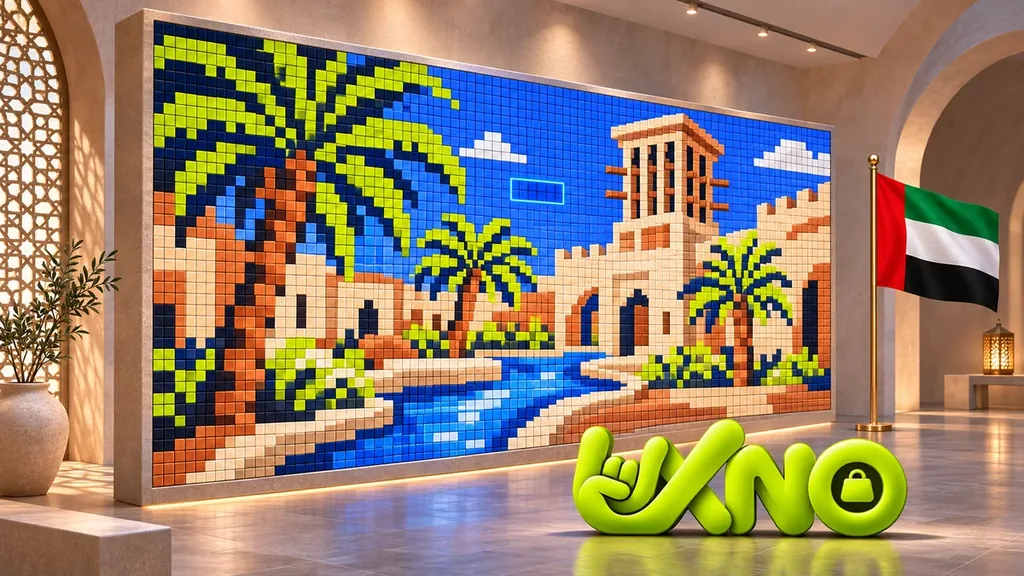
A small courtyard on the Pixel Wall
A palm-shadow sketch or courtyard detail could mark your creative work on the EXNO Pixel Wall. Its 1,000 × 1,000 grid costs $1 per pixel; choose a rectangle, pay once, and add an image or color, a title, and an optional link. EXNO reviews each submission and fully refunds unapproved ones. Approved areas remain on the wall, which is also pinned on EXNO’s social accounts. Sellers can use earnings; others pay by card. The proceeds support EXNO’s growth. Consider a small original composition as your contribution, without expecting visits or sales.
Questions about choosing a UAE digital product
These questions help narrow the work before you invest in filming, coding, or designing. They focus on the actual deliverable, the language, and what you can responsibly claim to a buyer.
Do I need a full course to start?
No. A complete tool, a finished artwork set, or a tightly scoped digital service can stand on its own. Choose a result you can demonstrate and deliver reliably; a longer package is useful only when its extra parts help the buyer.
Should every UAE product be in Arabic and English?
Choose according to your intended users. An educator may need both, while a specialist buyer may prefer one language with a glossary. If your listing promises two languages, include the actual content and instructions in both, and explain which variety of Arabic appears in recorded speech.
What if I do not know an Emirati craft or performance tradition well?
Work with a knowledgeable practitioner and agree their role, credit, and permitted uses. You could contribute filming, editing, software, or accessible captions while they contribute the cultural knowledge. Do not present generic decorative work as an authoritative lesson in a tradition.
Can I sell a lesson that uses Hope mission data?
You can develop an original teaching product, while checking the access and reuse conditions of any source material you include. Keep the paid value in your code, explanations, and exercises; the mission’s Science Data Center provides free data access after registration.[7] Direct learners to the original source when redistribution has not been established.
Does a local source prove that the product will sell?
No. A source can establish that a craft, research activity, buyer group, or event exists. To assess your proposed offer, show a useful sample to relevant people and investigate what they still need. None of the example prices in this guide is evidence of completed sales.
Is the amount after 7% commission my profit?
No. It is the example sale price with only EXNO’s sales commission subtracted. Other applicable charges, taxes, and the costs of creating or delivering the work are outside that figure, so it should not be treated as profit or a confirmed payout.
Sources and what they establish
The cultural institutions, research organizations, public authorities, and event organizers below support the local facts and dates used here. The proposed products, target buyers, and example prices are EXNO’s editorial suggestions. These sources do not certify demand, endorse the proposals, or license their images for reuse. All sources were checked on .
- Al Shindagha Museum / Dubai Culture — Traditional Windtowers (Barjeel). Explains the shaft’s connection to the space below and passive ventilation.
- Department of Culture and Tourism – Abu Dhabi — Talli. Describes braided garment decoration, materials, tools, and transmission between generations.
- Abu Dhabi Culture — Pearl diving. Documents the historical crew roles used as context for the original drama proposal.
- UAE submission hosted by UNESCO — Mleiha tentative-list entry. Provides settlement and trade context; the cited entry is tentative, not an inscription.
- Sharjah Archaeology Authority — Jabal Al-Emaileh Tomb I. Records Bronze Age ceramics and a later intrusive burial near Mleiha.
- UAE Space Agency — Emirates Mars Mission. Describes the mission’s atmospheric objectives and different instruments.
- Emirates Mars Mission — Science Data Center. Explains source-data access, available documentation, and related tools.
- Abu Dhabi Media Office / EAD — Marine aerial survey. Documents the local use of aerial observation to monitor marine species.
- Dugong and Seagrass Research Toolkit — Abundance aerial survey guidelines. Explains environmental and observer limitations, including animals present but not detected.
- Ramsa Lab — Emirati dialect documentation. Establishes the project’s attention to natural speech and variation in Emirati dialects.
- Abu Dhabi Culture — Al-Ayyala. Describes facing rows, coordinated performance, musicians, and local variation.
- UAE Government — Fact sheet. Establishes Arabic as the official language and Arabic–English commercial-sign context.
- Dubai World Trade Centre — Host your event. Supports the exhibition and business-event context, without supplying prices or a demand estimate.
- UNESCO — Cultural Sites of Al Ain. Documents the oasis landscape used as a place reference for original artwork.
- Dubai Department of Economy and Tourism — Hospitality services. Identifies holiday-home providers within the local hospitality sector.
- Ministry of Education — 2026–2027 academic calendar. Gives the school-calendar scope, break starts, and July 2, 2027 end date.
- Ministry of Education — Three-year calendar announcement. Confirms January 4, 2027 as the post-winter return date and explains curriculum exclusions.
- FAHR — 2026 Eid Al Etihad federal holiday announcement. Published November 13, 2026; distinguishes the federal leave period from the December 2 national occasion.
- Emirates Literature Festival — Official organizer. Announces the April 14–20, 2027 festival dates.
- EXNO — Current commission rates. Confirms 7% for standard sales and 7% for Discover, with other applicable charges addressed separately.
Original images and credits
The three concept illustrations were created for this article with ChatGPT image generation on November 25, 2026, using EXNO’s supplied glossy green wordmark and hand symbol. They depict imagined compositions, not documentary photographs, real software screens, or the live Pixel Wall. No source institution’s photographs, scans, or logos are included.
Product ideas and example prices are illustrations, not earnings estimates.


Choose the first useful version
Pick one buyer, one problem, and one deliverable from this guide. When its sample and usage terms are ready, give the product a clear place to be understood.